
CALL US AT:
Get in Touch With Us
Home » News »
Google is slowly launching its Merchant Center Universal Commerce Protocol (UCP) integration hub to U.S. merchants. The new integration layer lets retailers bind their shopping and checkout experiences more closely to Google. Search Engine Land reported the launch on October 6, 2026.
It marks a shift in the role of Google UCP from limited checkout capabilities to a more extensive integration layer within Merchant Center. Here are some of the key details for merchants to consider.
The Universal Commerce Protocol is a newly introduced open standard for agentic commerce. As described by Google, the protocol allows for agent and system coordination across the commerce ecosystem, essentially establishing a set of common rules that shopping platforms, generative AI assistants and merchants can adhere to.
According to Google, merchants who participate in the UCP will be able to add a checkout button to eligible product listings, which appear in AI Mode in Google Search and in Gemini. The company has been promoting the development of agentic commerce, where AI-driven systems are used to research, add and purchase items.
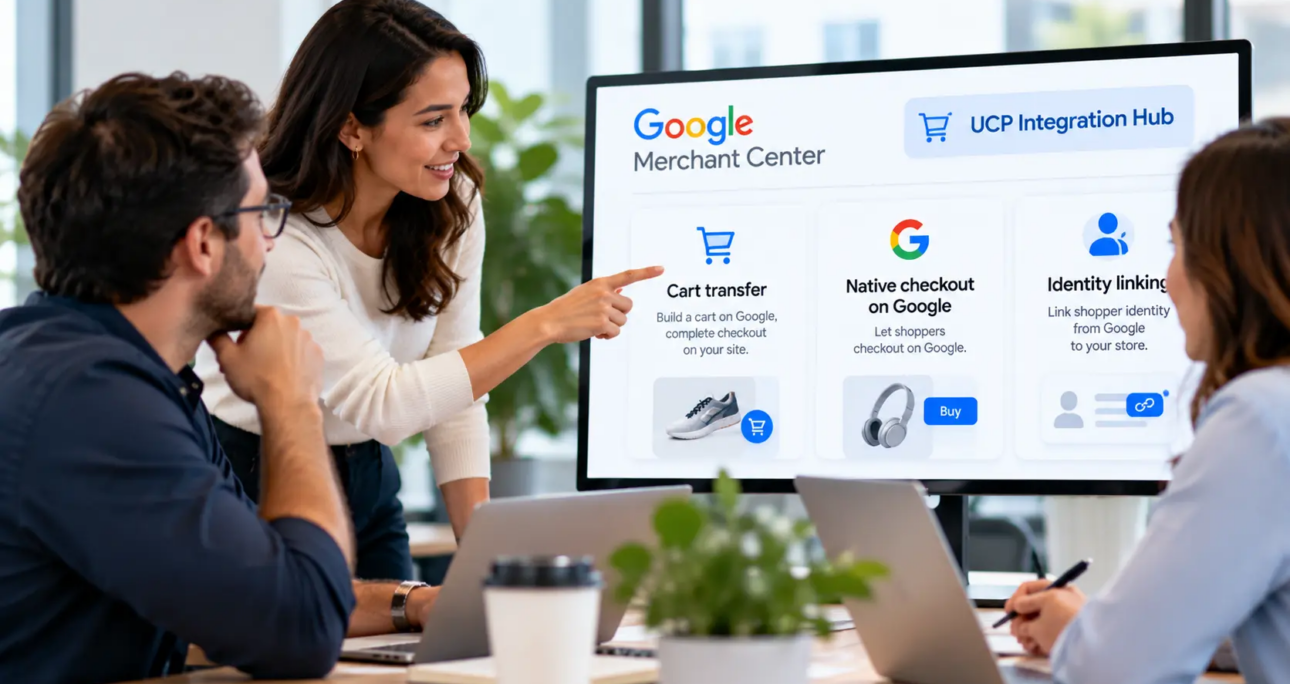
Eligible merchants can now decide which universal checkout (UCP) capabilities they want to support. Previously, the sole option was a specific checkout experience.
Merchants can now choose between three capabilities:
Each capability represents a different “flow” between Google and the merchant’s commerce environment. By offering these multiple options, Google has created more flexibility for merchants to determine their preferred approach to managing customer identity and checkout processes.
The hub is rolling out gradually, and the United States comes first. Google has shifted the timeline for other markets. Australia and Canada are now expected to follow next year.
Gradual means not every U.S. merchant will see it right away. Google’s help page notes that merchants may start to see the hub appear in their Merchant Center account as the onboarding experience reaches them.
Google has made further changes to its documentation. In particular, the company has renamed the corresponding Merchant Center help page to reflect the UCP integration hub and deleted the relevant FAQ mentioning UCP-powered checkout for select U.S. merchants
The changes in the documentation confirm the initial reports regarding Google’s plans to revise the current approach. The previous language implied that the company only intended to onboard specific merchants. In contrast, the revised documentation mentions a general onboarding path..
To onboard, a merchant needs to complete three steps and pass three checks.
This is a selection process, which means that simply expressing interest is not enough. Google will notify the merchant when they have been selected and can then begin onboarding within Merchant Center.
In addition, selected merchants also receive a sandbox environment in which they can test their integration before launch. Google notes that the sandbox allows merchants to verify their UCP profile, cart transfer to a merchant site, and native checkout APIs.
The Merchant Center will highlight issues, notifying merchants when they need to update feed attributes, returns or account configuration so that teams can spot gaps before customers do.
Merchant Center is where most companies begin their journey, preparing product data. Google promises to maintain Merchant Center as the place where merchants organize data for advertising and product listings on Google.
Google recommends that merchants keep product data and brand assets as up-to-date and high-quality as possible. The company has published a complete implementation guide for Merchant Center in Google’s developer documentation.
Many merchants operate their commerce via a 3rd party platform or service provider. Google’s guidance to them is straightforward: reach out to their 3rd party provider to understand their approach for UCP integration.
As such, for merchants that are on 3rd party platforms, it may be the responsibility of said 3rd party to support UCP. The Merchant Center hub may not be sufficient in these cases.
Search Engine Land highlights friction. A checkout process streamlined into the shopping journey could help reduce friction between finding and buying a product, crucial in a world where Google is building in AI-powered shopping features.
Early adopters could also benefit from a head start. Merchants that tie in early could have an advantage in a commerce space where shoppers are using AI agents to help with their research, purchasing and more.
That’s a strong argument, but one that depends on Google’s ability to grow and scale its AI shopping surfaces and the number of consumers who will use them.
Begin by learning the basics. You will want to review the UCP developer guide and see what technical work your team would have to do. You should also find out whether your platform or provider announced availability.
Next, audit your Merchant Center data. Feeding strong products and brand assets to Google is the most important preparation, according to the search giant. Now choose the right capability for your business. Some retailers will want to drive customers to their website by using the cart transfer, while others will consider using native checkout on Google or linking their identity.
The last step is to fill out the interest form if universal checkout payment is suitable for your business. The selection process can be long, so start early.
Q 1: What is the Universal Commerce Protocol?
It is an open standard for agentic commerce. It enables agents and systems to collaborate across the commerce ecosystem. Google uses it to power checkout on eligible listings in AI Mode and Gemini.
Q 2: What is the UCP integration hub?
It is a section of Merchant Center where eligible merchants select capabilities that they want to support. Options include cart transfer, native checkout on Google and identity linking.
Q 3: Who can use it now?
It is available on a rolling basis to merchants in the United States. Not all merchants will see it at the same time. Selection is a part of the process as well.
Q 4: When will it reach other countries?
Google says Australia and Canada are expected to follow next year. The timeline for other markets has shifted.
Q 5: How do merchants join?
They complete the technical implementation in the UCP developer guide and fill out an interest form. Google then notifies selected merchants. Those merchants get access to onboarding in Merchant Center.
Q 6: Is there a way to test the setup?
Yes. Selected merchants get a sandbox environment. It lets them validate their UCP profile, cart transfer and native checkout APIs.
Q 7: Will Merchant Center still manage product data?
Yes. Google says it remains the central hub for preparing product data for ads and listings. Accurate feeds and brand assets are the best preparation.
Q 8: What if I use a third-party platform?
Contact your provider directly. Google advises merchants to ask about the provider’s plans for UCP integration.
Q 9: Can I choose which features to enable?
Yes. Merchants can pick the UCP capabilities they want to support. That includes cart transfer, native checkout and identity linking.
Newsletter Signup
X has introduced a new ad product called X Lift that uses artificial intelligence to
Reddit has announced a set of upgrades to its Lead Gen Ads. The updates are
Google Ads is set to expand its Conversion Lift feature to include Search and Performance
Meta announced changes to its advertising business during its Advertising Week event in New York
Google has started giving certain site owners an indication of the percentage of users who
Google is slowly launching its Merchant Center Universal Commerce Protocol (UCP) integration hub to U.S.
Take the next step towards transforming your digital marketing and achieving unparalleled growth. Whether you’re looking to refine your strategy, boost conversions, or build a dominant online brand, ALM Corp has the expertise to make it happen.
Drop us an email
info@almcorp.com
Toronto
80 Atlantic Ave, 4th Floor
Toronto, ON, M6K 1X9
New York
413 W 14th St Ground Floor and Suite #200, New York, NY 10014
London
Mappin House, 4 Winsley St,
London W1W 8HF, United Kingdom
Join Our YouTube Community
Services
White Label Services
Resources
About Us
Join Our YouTube Community
© Copyright 2026 | ALM Corp | All Rights Reserved.
Google Rolls Out Its UCP Hub for U.S. Merchants (2026) – ALM Corp
Related Posts
 out 10, 2026
out 10, 2026
out 10, 2026
out 10, 2026
out 10, 2026