
Meta Platforms Inc banned advertisements in the US from ByteDance Ltd (字節跳動), the former controlling owner of TikTok, intensifying the competition with the popular social video site.
On Thursday, Meta began implementing a complete restriction on ads and paid marketing messages placed on its platforms by ByteDance, the Chinese company that remains in charge of key parts of TikTok in the US.
The ban is to take effect in the US, Canada, Egypt, Indonesia, Japan, Thailand and Vietnam, according to Meta, and also extend to third-party advertisers running campaigns that link to TikTok and other ByteDance properties in those countries.
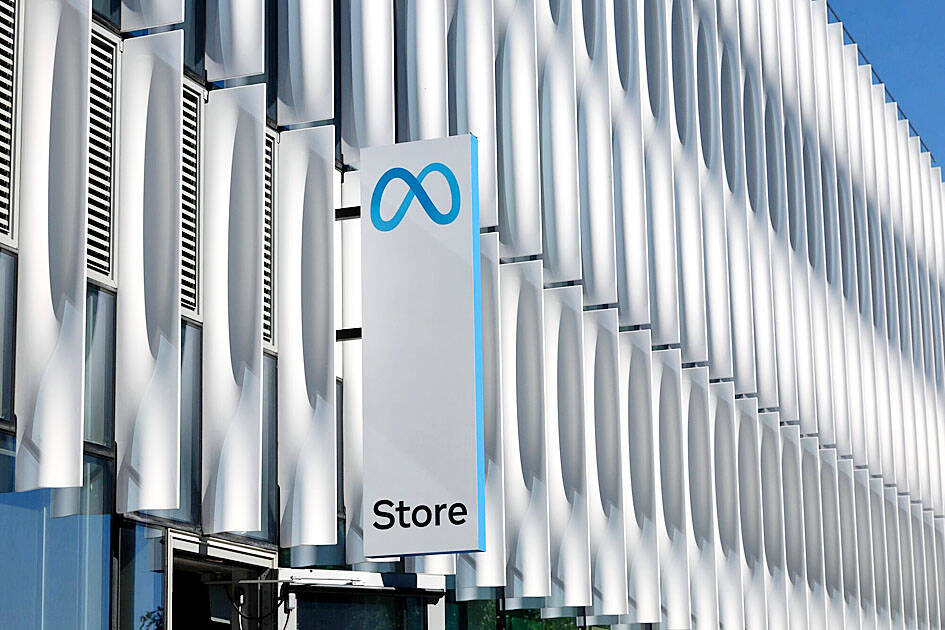
Photo: Bloomberg
“We don’t have to run ads from a competitor whose goal is to pull people off our apps,” Meta spokesperson Chris Sgro said in an e-mailed statement. “Declining promotional services to a competitor is a normal business practice across industries. We will continue to compete on product quality and user experience.”
Meta and TikTok have competed neck-and-neck for years, even with a key imbalance in that rivalry: TikTok has been able to operate in Meta’s most important market, the US, while Meta has been unable to do so in TikTok’s most crucial market, China. However, that competition took a more heated turn in August after Meta agreed to a historic US$18 billion settlement with US states requiring it to implement new safety features for minors across its Instagram and Facebook apps.
Since then, Meta has been pressuring TikTok and Google’s YouTube to commit to making similar changes, suggesting it cannot solve industrywide child safety problems on its own.
TikTok has remained publicly silent on the matter, ratcheting up the tension between the companies as Meta grapples with what it sees as yet another competitive disadvantage.
Last month, TikTok enacted a number of measures to make it harder to shift from its app to other social platforms, including by eliminating dedicated Instagram links from its users’ profiles. It also rejected ads from Meta demanding that TikTok commit to comparable concessions on child safety.
Soon after the settlement with the state attorneys general, Meta ran ads in top newspapers upping its pressure campaign. Meta executives have also called out TikTok publicly for failing to show up at a recent Office of the Surgeon General event on the harms of excessive screen use, and for dropping out of a national security meeting with the House Select Committee on China to avoid broader scrutiny amid its child safety litigation.
Other consumer tech platforms have also introduced friction between its products and its competitors. The Information reported last month that OpenAI told advertising partners that it would not accept ads for image and audio-generation products that competed with its own.
Bankers in Hong Kong skipped the summer break as an artificial intelligence (AI)-fueled rush for capital sent share sales to a record, defying a bruising selloff in the city’s stocks. Initial public offerings (IPOs), placements and block trades raised US$47.5 billion in July to last month, the biggest haul ever for the period, data compiled by Bloomberg showed. That pushed fundraising this year above US$92 billion and within reach of the US$112.5 billion record set in 2021. AI has been at the heart of Hong Kong’s deal revival, but this summer brought a new level of intensity. Chinese companies raised ever-larger sums
SILICON ISLAND: When asked about geopolitical tensions, Lisa Su said that ‘Taiwan is absolutely critical to the semiconductor supply chain, and very, very critical for AMD’ Advanced Micro Devices Inc (AMD) CEO Lisa Su (蘇姿丰) yesterday said the company plans to “substantially” increase manufacturing capacity next year through its Taiwanese supply chain, particularly with Taiwan Semiconductor Manufacturing Co (TSMC, 台積電), as surging demand for artificial intelligence (AI)-related processors continues to outstrip supply. “It is a very exciting time right now for all kinds of compute, and especially on the CPU [central processing unit] side,” Su said during a visit to Taiwan. “The overall market has increased a lot in 2026, and so we have also increased our own supply and capacity in 2026, but I can
INDUSTRY STANDARD: Most global semiconductor companies have tied employee bonuses directly to corporate profits, the union said, urging Micron to do the same Micron Memory Taiwan Co’s (台灣美光) Taoyuan union secured strike authorization yesterday after a six-day vote, ramping up pressure on management to build a reasonable profit-sharing mechanism. Before the strike, the Taoyuan union “encourages” members to join a protest in Taipei on Oct. 19, union chairman Jerry Lin (林哲瑞) told a news conference in Taipei. The union did not rule out staging a snap strike, Lin said. The union has 2,258 registered members, with 88.3 percent backing the strike, he said. The vote comes as Micron’s board of directors is meeting today and tomorrow in the US. The union expects the board to respond
Elon Musk said his business empire would build and operate Terafab independently, quashing speculation about industry leader Taiwan Semiconductor Manufacturing Co (TSMC, 台積電) swooping in to run his ambitious chipmaking venture. Based in Texas, the Terafab project is Musk’s effort to break into the business of fabricating chips, in service of his companies Tesla Inc and SpaceXAI. While Musk had said that he was in discussions with TSMC, the trillionaire clarified in an X post yesterday that the only matter under consideration is for TSMC potentially leasing some part of the planned site and would not involve any operational role. “Maybe TSMC
Meta bans ads from TikTok on its apps – Taipei Times
Related Posts
 out 11, 2026
 out 11, 2026
 out 11, 2026