
CALL US AT:
Get in Touch With Us
Home » News »
Google has begun testing ads in AI Mode for users who connect their apps to Personal Intelligence. This flips the initial strategy on its head. Personal Intelligence was initially ad free, and Google has now confirmed they are beginning to test ads for users who opt in
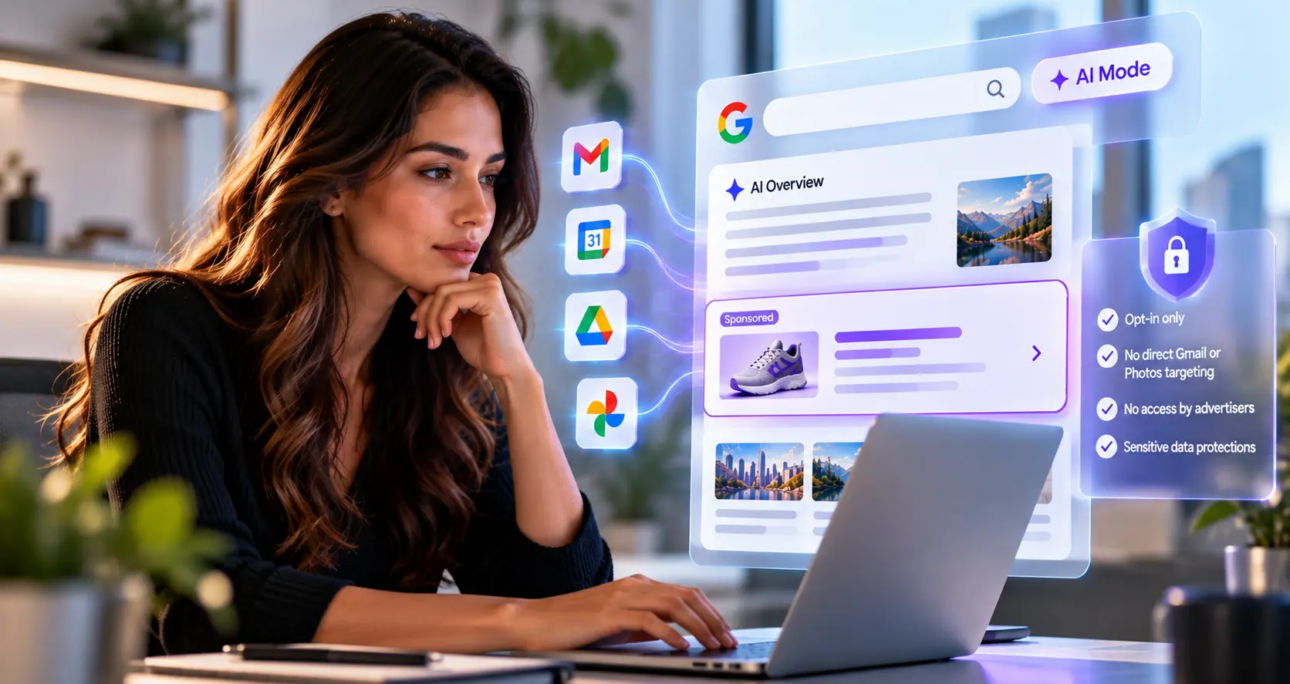
In practice this involves data. Google may begin using insights from connected apps to help personalize the ads users see in addition to the information it uses to power AI-powered responses. Advertisers don’t get access to the apps and Google lists several protections it says are in place.
Search Engine Land’s Anu Adegbola reported the news on October 16, 2026. For now it’s a test, not a rollout.
According to Google, the ads could keep reflecting factors including what the user queried, the context of the AI-generated response and their interests. The new piece is the additional part being added.
The ad-free beginning was probably providing Personal Intelligence a cleaner look than a typical results page. Adding ads, even a limited test for users who have linked apps, changes that image. Google has not announced a wide deployment.
Personal Intelligence enables AI Mode to use limited information from associated Google apps, such as reports and summaries, to create more pertinent responses. Under the new trial, that same information could also be utilized to customize the advertisements that individuals see inside AI Mode.
The example provided is straightforward. AI Mode could employ context from connected apps to better understand what a person needs, thus potentially making the advertising more pertinent. What kinds of insights would be considered in practice is not specified in the coverage.
It seems less like a separate advertising system and more like an additional layer of context, however. The individual’s query and the AI-generated response are still a part of the picture.
Because the context of the AI-generated response is one of the factors, however, the answer can influence which ads appear. Insights from connected apps provide an additional input to the mix.
Google has not said why, but it is simple to guess for those who understand the ad tech ecosystem. For years, search ads have been based primarily on the query entered by the user. Personal Intelligence adds context from apps that the user has selected to connect to, and Google can also use that information to influence ads. It is a different type of signal than a keyword, and it is not accessible to advertisers.
Google lists out four different protections that still remain:
The language of the four points makes it sound like limitations on what Google can do, rather than options open to advertisers.
One nuance may be easy to overlook: while ads will not use the content of Gmail or Photos, the test uses inferences and summaries derived from connected applications. The coverage does not specify exactly where that line might be drawn, and it is probably the area in which questions will be raised first.
Google has also updated its privacy policy to clarify how connected-app information may be used for ad personalization. A policy change alongside the test suggests Google wants the new use of data on the record. Anyone who has connected apps to Personal Intelligence may want to read the updated language.
Search Engine Land’s coverage links to a Google help page on connecting content apps for a tailored Search experience.
While for the advertisers, the context is more appealing: if the test extends, the ads can reflect a broader understanding of the interests and needs rather than a single query.
The limitations are clearer, as the advertisers cannot access connected apps and Google has not announced new advertiser controls, targeting options, or a wider release. The coverage, for now, does not reveal any setting for the advertisers to turn on.
As for the paid media teams, the immediate impact is limited: the coverage does not report any changes to the campaign construction or bidding. The key question is whether the personalized ads in AI Mode will extend beyond the connected apps users.
Whatever changes, they are on Google’s side: any insights from connected apps could influence the ads the users see, while the advertisers cannot reach these apps directly.
Some questions are worth asking after the test run. The coverage does not say how many users are being used in the test, how long the test should be, and what would trigger the expansion into a larger launch. All of these would be indicative of a short-term test or a launching pad for an extended expansion.
Since advertisers cannot view connected apps, they cannot see the contexts that may have triggered a particular ad. The coverage did not report on any reporting features that would explain those influences, muddying potential results
There is also a trust issue at stake, as many of those connecting apps to Personal Intelligence are likely doing so for enhanced results, and could be surprised that that access could be used for advertising. While opt-in access and the ability to disconnect could help, the real-world usage will matter more than the measures in place.
Google’s test launches on the same day that Search Engine Land reported on new measurement tools and visual ad formats for ChatGPT Ads. ChatGPT’s updates include extended measurement partnerships and tests of larger images and wider ad cards, and both stories can be seen as examples of ads within AI apps pushing on multiple fronts at once.
Q1: What did Google announce about ads in AI Mode?
Google confirmed that it is starting to test ads in AI Mode to people who have connected their apps via Personal Intelligence (PI). It had previously been ad-free. Google could now use the insights from connected apps to help personalize ads for these users.
Q2: What is Personal Intelligence in AI Mode?
Personal Intelligence lets AI Mode use limited information from connected Google apps, such as insights and summaries, to give more relevant responses. Users have to choose to connect their apps, and Google’s help page on connecting content apps explains the tailored Search experience. Under the new test, the same information may also help personalize ads.
Q3: Will ads use the contents of Gmail or Google Photos?
Google says ads won’t be based directly on the contents of a user’s Gmail inbox or Google Photos library. The test does use insights from connected apps, though, so the line appears to sit between raw content and derived insights. Google also says sensitive information won’t be used to personalize ads.
Q4: Can advertisers see users’ connected apps?
No. Google says advertisers won’t be able to access users’ connected apps. Insights from those apps may still help determine which ads users see, but that happens on Google’s side, and the coverage doesn’t say how it will be reported.
Q5: Is this ad test available to every AI Mode user?
No. It’s aimed at users who opt into connecting their apps through Personal Intelligence, and Google hasn’t announced a wider rollout. Users can also disconnect their apps at any time.
Q6: Can users disconnect their apps?
Yes. Connecting apps is opt-in, and users can disconnect them at any time. Google has also updated its privacy policy to clarify how connected-app information may be used for advertising personalization.
Q7: What factors will the ads reflect?
Google says ads will continue to reflect factors such as the user’s query, the context of the AI-generated response and their interests. The new element is information from connected apps, which may now help personalize the ads as well.
Q8: Are there new controls for advertisers?
Not at this stage. Google hasn’t announced new advertiser controls, targeting options or a wider rollout for the test. Advertisers also can’t access connected apps directly, so the personalization happens without their input.
Q9: Why does this test matter for advertisers?
It points toward a more personalized version of AI Search, where ads could reflect a broader understanding of people’s interests and needs than a single query provides. That’s the potential, though it depends on whether the test expands beyond users who connect their apps. Advertisers have no new controls to work with yet.
Q10: What should marketers watch next?
They should be looking out for new controls in general, a wider rollout and any performance reporting that might come. They should also monitor when ads appear in AI Mode for their category, as only users who connected their apps are included. The coverage has not mentioned reporting for this test.
Newsletter Signup
Meta has announced four new tools for brand advertisers on Facebook and Instagram. They’re called
Open AI has launched several changes to ChatGPT Ads recently, and most of them are
OpenAI appears to have removed UTM tracking from links in ChatGPT. If accurate, it would
Google has begun testing ads in AI Mode for users who connect their apps to
Google has launched a new set of updates to AI Mode and AI Overviews. Most
Google simplified one of the more annoying rules of building your own Android app. Starting
Take the next step towards transforming your digital marketing and achieving unparalleled growth. Whether you’re looking to refine your strategy, boost conversions, or build a dominant online brand, ALM Corp has the expertise to make it happen.
Drop us an email
info@almcorp.com
Toronto
80 Atlantic Ave, 4th Floor
Toronto, ON, M6K 1X9
New York
413 W 14th St Ground Floor and Suite #200, New York, NY 10014
London
Mappin House, 4 Winsley St,
London W1W 8HF, United Kingdom
Join Our YouTube Community
Services
White Label Services
Resources
About Us
Join Our YouTube Community
© Copyright 2026 | ALM Corp | All Rights Reserved.
Google Starts Testing Ads in AI Mode for Users with Personal Intelligence Enabled – ALM Corp
Related Posts
 out 22, 2026
out 22, 2026