
Final URL expansion is a Google Ads setting that lets AI replace an ad's chosen landing page with another page on the same domain and write ad text to match it.
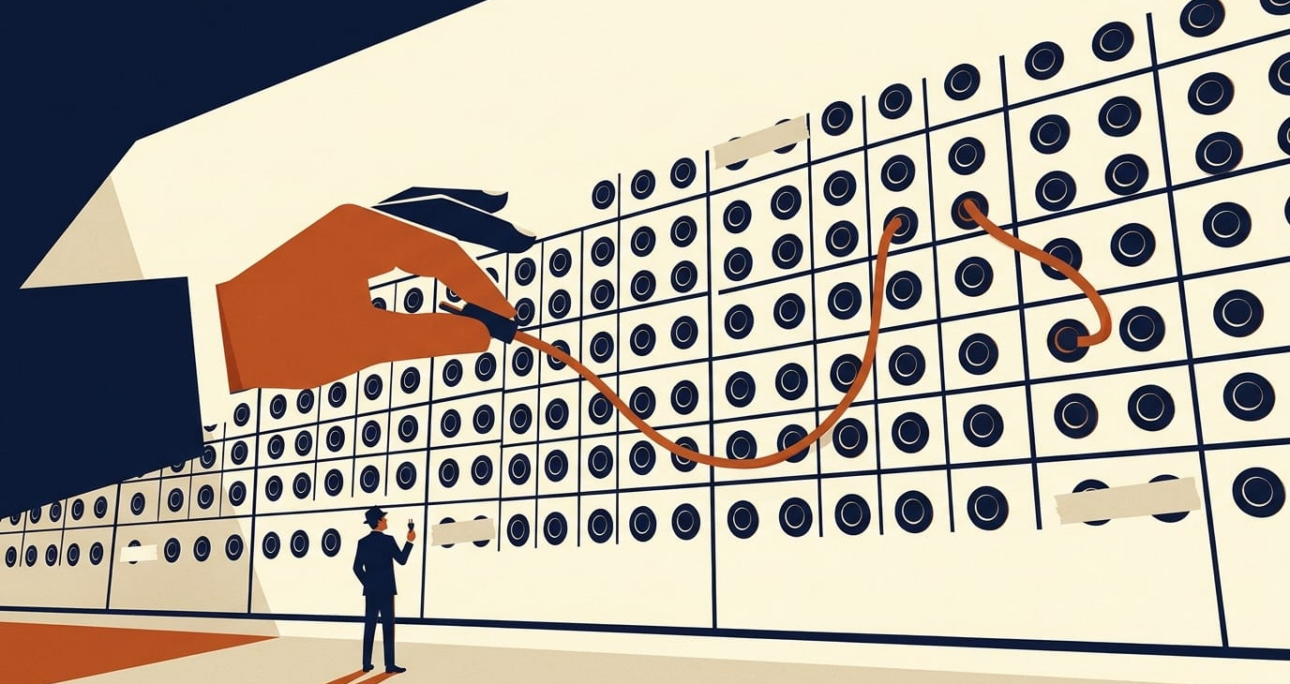
Final URL expansion is a campaign setting in Google Ads and Microsoft Advertising that allows the platform to send a click to a page other than the one the advertiser entered as the ad’s destination. The replacement page must sit on the same domain as the original final URL, the address an advertiser supplies as the landing page. Google’s Performance Max help page says the feature can “replace your Final URL with a more relevant landing page from the Final URL domain, based on the user’s search intent.” It exists because a single advertiser-chosen page rarely fits every query a broadly targeted campaign can match. A search for a specific running shoe that lands on a general footwear page loses intent on arrival; the setting routes that click to the product page and rewrites the ad to match.
The mechanism has three parts. The system reads the advertiser’s website, much as Dynamic Search Ads (DSA) did, indexing pages that could serve as destinations. At auction time it compares the query and its inferred intent with that index and decides whether another page beats the supplied final URL. If it swaps the page, it generates ad text to fit. According to Google’s Search help page, when text customisation and final URL expansion are both on, Google “may replace your Final URL with a more relevant landing page” and “generate dynamic headline, description, and additional assets” matching that page’s content.
That dependency on generated text is structural. In AI Max for Search, “‘Text customization’ must be enabled” to use the setting, and switching off text customisation switches off final URL expansion too. The Google Ads API documentation, last updated October 14, 2026, puts it the other way round for Performance Max: enabling final URL expansion “also enables text customization,” and an advertiser “cannot opt out of text customization if final URL expansion is active.” In the API the switch is an asset automation setting, FINAL_URL_EXPANSION_TEXT_ASSET_AUTOMATION, held in a campaign’s asset_automation_settings. Exclusions are written as WEBPAGE campaign criteria.
Defaults differ by campaign type. In Performance Max, Google’s cross-channel campaign type, final URL expansion “is turned on by default,” and it is not available to Performance Max campaigns running only store goals. In AI Max for Search, Google calls it “an opt-in, campaign-level setting,” but it is switched on by default once an advertiser opts into AI Max. In Search, Google says it “will only send traffic to URLs that are query relevant and themed to your ad group.” Microsoft’s interface, as reported when AI Max reached all Microsoft accounts, describes the redirect as happening “when it’s likely to improve ad performance.”
Because the setting can reach any indexable page on a domain, most of the work around it concerns limits. Google offers four controls.
The controls have gaps. A campaign’s own final URL “can’t be excluded” through expansion exclusions, according to Google’s URL exclusion page, so stopping a homepage from serving requires choosing a more specific final URL first. And in campaigns with a Merchant Center feed, “your homepage may still serve on some inventory even if excluded,” with Shopping ads on Gmail cited as the example.
For reporting, Google’s AI Max reporting page lists a landing pages report whose “Selected by” column flags pages AI Max chose, and an “Expanded final URL assets” tab pairing generated assets with the URLs they served on.
Final URL expansion launched with Performance Max. Google began rolling Performance Max out to all advertisers on November 2, 2021, describing “our new Final URL Expansion feature” and advising advertisers to keep it on, according to its launch help article. The idea itself was older. Google introduced Dynamic Search Ads in beta on October 20, 2011, generating headlines and choosing landing pages from crawled site content. What changed was that the page selection now sat inside a campaign that also chose channels, audiences and creative.
Controls came later. Page feeds came to Performance Max in 2023; Google’s what’s new page, dated February 23, 2023, describes the feed as a way to “inform and guide Google’s AI” when expansion is on. In July 2023 Google offered DSA advertisers a path into Performance Max, according to MediaPost, and URL contains rules later followed from DSA. On February 16, 2024, Google’s Ads Developer Blog said that page feeds required text asset automation to be on, returning API errors from February 15, 2024 and removing incompatible feed links from April 15, 2024. By August 2025 Google had finished rolling out final URL expansion asset reporting and rules-based URL exclusions for Performance Max.
Microsoft followed. Its Performance Max introduction, dated July 26, 2023, recommended “keeping this setting on to send traffic to the most relevant landing pages on your site.”
The second phase brought the setting into Search. Google announced AI Max for Search on May 6, 2025, bundling search term matching, text customisation and final URL expansion; a Google live stream in October 2025 confirmed that asset pinning required final URL expansion to be disabled. Google’s AI Max update of April 30, 2026 added text disclaimers, because advertisers in regulated industries had previously been able to keep required text only when not using expansion. Brandon Ervin, director of product management at Google Ads, wrote that “it’s become impossible to manually choose the right page for every query.”
The setting moves a decision advertisers and landing page teams used to own. Landing page testing assumes a fixed destination per ad; expansion breaks that assumption, and some tracking with it. PPC Land reported that static tracking templates without an {lpurl} tag can send users to the tracking destination itself once expansion is active, and that nonstandard constructions can return 404 errors. Google itself warns marketplace sellers and multi-domain advertisers of “mismatched headlines or descriptions.”
Scale makes this pressing. When Google said on April 15, 2026 that it would retire Dynamic Search Ads and upgrade them to AI Max, it said migrated DSA campaigns would run all three AI Max features, final URL expansion included, with existing URL controls preserved. For accounts where DSA carried most search volume, the setting becomes the default way search traffic reaches a site.
The central dispute is whether the uplift is real. Google’s claim for the full AI Max suite fell from 14% more conversions at similar cost in May 2025 to an average of 7%, based on internal 2026 data that excluded retail advertisers. Independent analyses have been less favourable: Ezra Sackett of Monks reported that 99% of AI Max impressions across about 30,000 search terms produced no conversions, and an analysis of more than 250 retail campaigns put AI Max at roughly 35% lower ROAS, or return on ad spend, than traditional match types. Neither study isolated final URL expansion from search term matching, and Google publishes no separate figure for the setting.
Control is the second complaint. Pinned responsive search ad assets are ignored when a different URL is selected or URL inclusions are active, and excluding a page relies on knowing it exists, which favours small sites over large catalogues. Google’s own optimisation experiment lets advertisers split traffic between arms with and without expansion, but the campaign must have it switched off to start.
Defaults now depend on how a campaign arrived. Google began automatically converting Search campaigns using automatically created assets or the campaign-level broad match setting on September 1, 2026. According to Google’s DSA upgrade post, updated June 11, 2026, the first group receives search term matching and text customisation but not final URL expansion, and the second receives search term matching only. A second PPC Land analysis published the same day said expansion would apply to that cohort, which Google’s post does not state. DSA campaigns, which do receive the setting, were moved to February 2027. On July 13, 2026, Search Engine Roundtable reported that Google Ads had added side-by-side previews of text customisation and final URL expansion. Microsoft began rolling AI Max out to all accounts globally on August 19, 2026, with an “Exclude specific URLs” control beneath the expansion checkbox.
Who: Google, which built the setting into Performance Max and AI Max for Search; Microsoft Advertising, which offers it in both products; and advertisers, agencies and landing page teams who decide whether to leave it on and which pages to exclude.
What: A campaign setting that lets the ad platform replace an advertiser’s chosen landing page with another page on the same domain, and generate matching ad text, when it judges the alternative more relevant to the query.
When: Launched with Performance Max on November 2, 2021; extended to Search through AI Max, announced May 6, 2025; made a default for upgraded DSA campaigns, now scheduled for February 2027.
Where: Inside Google Ads campaign settings under Asset optimisation or AI Max, in the Google Ads API as an asset automation setting, and in Microsoft Advertising’s Performance Max and AI Max panels.
Why: To match each query with the most specific page on a site, at the cost of advertiser control over destinations, pinned copy and tracking, and with performance gains that independent tests have not confirmed.
Every morning, get a curated digest of the last 24 hours in programmatic advertising
Final URL expansion – PPC Land
Related Posts
 out 25, 2026
out 25, 2026