
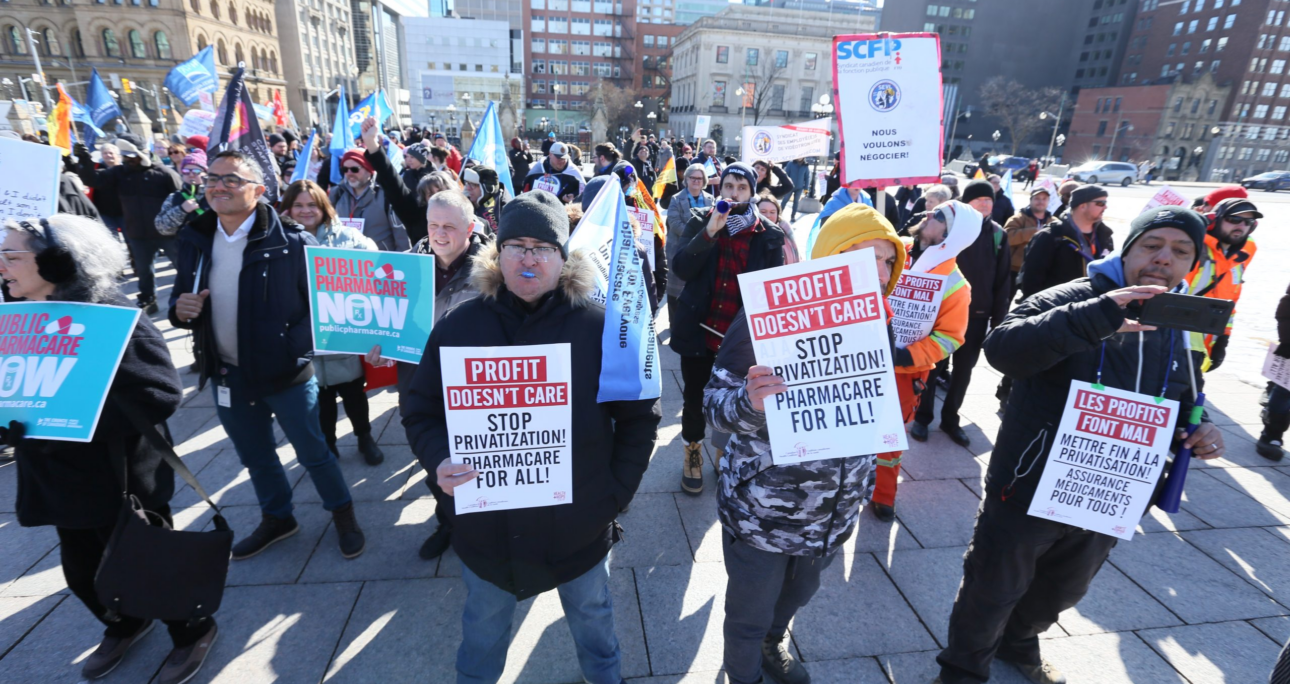
Rally for pharmacare on Parliament Hill on February 13, 2024. Photo: John Major
The insurance industry has lobbied policymakers about pharmacare dozens of times since the election of Prime Minister Mark Carney in April 2025, according to a group campaigning for universal drug coverage.
The Council of Canadians says it’s “deeply concerned” that industry lobbyists who oppose universal pharmacare have influenced the federal government.
Federal lobbying records show that insurance sector representatives lobbied decision-makers about pharmacare at least 53 times between April 28 and November 25, according to a statement from the group. The lobbyists represented the Canadian Life and Health Insurance Association and several major companies, including Manulife, Canada Life, Sun Life, and Greenshields.
Lobbyists met with decision-makers from Health Canada, Finance Canada, and the Prime Minister’s Office, along with MPs, Senators and other officials. For example, advisors to the federal health minister met 29 times with insurance sector lobbyists to discuss pharmacare.
At the height of the “behind-the-scenes pressure campaign,” industry reps met with policymakers about pharmacare up to three times a week, according to the analysis. Data published by the Council of Canadians shows a surge in activity in October, just before the budget was introduced.
“Insurance industry interests have taken full advantage of the ‘open door’ policy for corporate lobbyists adopted by the Liberal government, to the detriment of the millions of Canadians who are struggling to afford their medications,” said Nikolas Barry-Shaw, lead campaigner on pharmacare for the Council of Canadians.
In response to queries from the NB Media Co-op, the Canadian Life and Health Insurance Association, an industry association representing the vast majority of health and life insurance companies in Canada, provided an emailed statement from Karen Leiva, AVP, Strategic Communications & Public Affairs.
“The inferences in the release are misleading,” Leiva stated, while acknowledging that “the CLHIA and our members meet and regularly work with government officials” on various topics.
“This includes pharmacare, and our position on the issue is already public,” the statement continued. “There are 27 million Canadians who already have access to medications through employer-sponsored health benefits, and that’s a foundation we must protect. Every Canadian, regardless of income or employment, should be able to get the medications they are prescribed.”
The statement added: “As part of regular engagements with governments on this topic, Canada’s life and health insurers continue to encourage governments to focus on solutions to provide equitable coverage to those Canadians who currently do not have coverage under their workplace drug benefit plan.”
In the lead-up to the election, Carney pledged to provide “dental care and pharmacare for everyone who needs it” and the federal Liberal Party platform stated that a Carney government would “protect dental care and pharmacare.”
At a campaign event in P.E.I. last year, just days before the election, Carney said in a speech: “Pharmacare will provide free contraceptives to nine million Canadians and diabetes medication to almost four million Canadians. Pierre Poilievre will eliminate it because he thinks it’s everyone for themselves.”
The Pharmacare Act, which became law in October 2024, lays the groundwork for a national universal pharmacare program, with the first phase covering contraceptives and diabetes treatments.
Three provinces and one territory — Manitoba, B.C., P.E.I. and Yukon — have signed pharmacare agreements with Ottawa since then.
Carney told reporters in September that his government intends to follow through with pharmacare deals covering every province and territory. However, there was no new money for the program in November’s federal budget.
New Brunswick’s Liberal government under Premier Susan Holt — who promised free contraceptives in their 2024 election platform — has so far appeared lukewarm about pharmacare.
In September, provincial Health Minister John Dornan told public health care activists that the health insurance industry may respond to pharmacare by eliminating private coverage for Ozempic. That could leave the province with a multi-million dollar gap in coverage, since Ottawa doesn’t currently cover that medication.
Dornan previously stated that an offer from the feds wasn’t enough to cover the province’s pharmacare costs and that “New Brunswickers are already relatively well covered.”
But diabetes patients and public health advocates say there is widespread hardship among low-income people forced to choose between groceries, rent, and life-sustaining treatments.
New Brunswick would likely receive $136 million over four years through a bilateral agreement with Ottawa, according to an analysis published by the Canadian Centre for Policy Alternatives.
Canada is the only country in the world with a universal health care system but no universal coverage for medication outside of hospitals.
Last updated at 9:10 p.m. on Tuesday, Jan. 6, 2026.
David Gordon Koch is a journalist with the NB Media Co-op. This reporting has been made possible in part by the Government of Canada, via the Local Journalism Initiative.
New Brunswick’s Liberal government has officially responded to commissioner Manju Varma’s report on systemic racism by establishing an Anti-Racism Office…
The health insurance sector has upped its lobbying efforts in New Brunswick in opposition to universal pharmacare, government records show….
La langue française constitue le socle de la culture acadienne. C’était la phrase introductive de ma lettre d’opinion l’an passé…
The French language is the foundation of Acadian culture. That was the opening sentence of my opinion piece last year,…
© 2019 NB Media Co-op. All rights reserved.
© 2019 NB Media Co-op. All rights reserved.
Insurance lobbyists ramped up ‘pressure campaign’ against pharmacare ahead of federal budget: Council of Canadians – NB Media Co-op
Related Posts
 jan 19, 2026
 jan 19, 2026
 jan 19, 2026
