
January 22, 2026e-Paper
The View From India Looking at World Affairs from the Indian perspective.
First Day First Show News and reviews from the world of cinema and streaming.
Today's Cache Your download of the top 5 technology stories of the day.
Science For All The weekly newsletter from science writers takes the jargon out of science and puts the fun in!
Data Point Decoding the headlines with facts, figures, and numbers
Health Matters Ramya Kannan writes to you on getting to good health, and staying there
The Hindu On Books Books of the week, reviews, excerpts, new titles and features.
January 22, 2026e-Paper
Updated – January 22, 2026 09:37 am IST
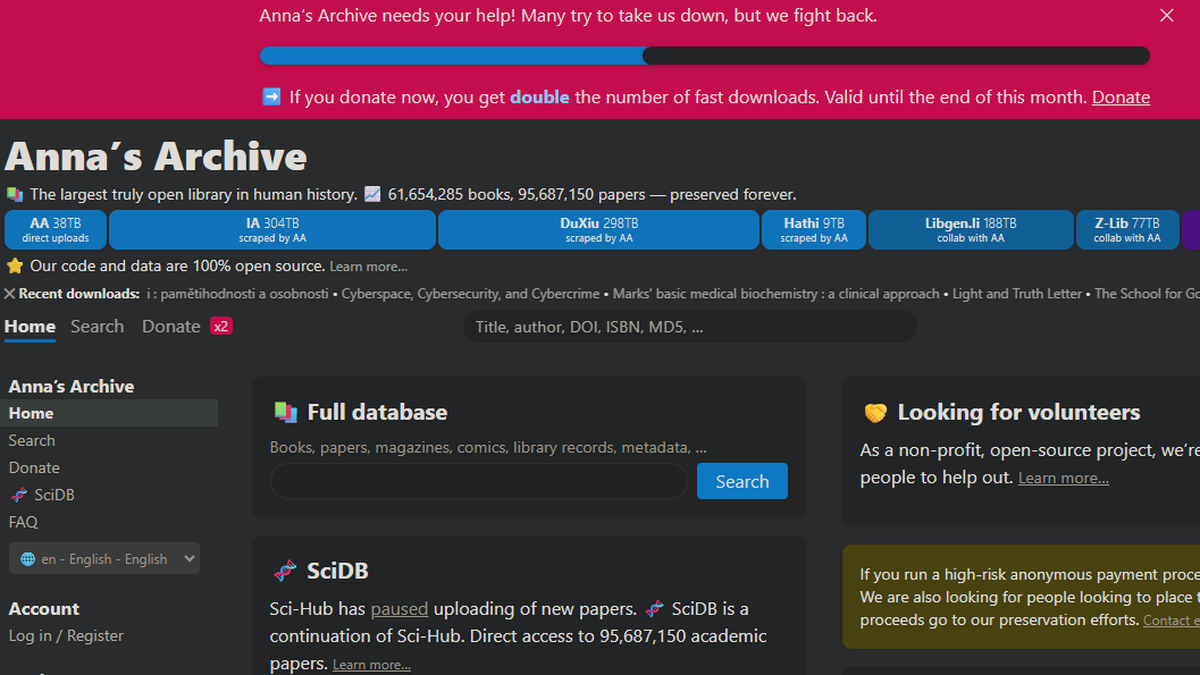
The landing page of Anna’s Archive is pictured above | Photo Credit: Anna’s Archive
In late December, a relatively little-known platform, Anna’s Archive, made global headlines after it hacked Spotify. Tracked closely by open source movement advocates, the database that indexes millions of digital books and journals claimed it had scraped from Spotify about 86 million music files and metadata coming to slightly under 300TB. The platform claimed it “saw a role for us here to build a music archive primarily aimed at preservation.” While the music collection is yet to be made fully available, the main web link to access Anna’s Archive is down globally. This sudden outage has left numerous users—academics, bibliophiles, and open source activists—in distress.
Anna’s Archive is a type of shadow library project that unifies existing libraries—both legal and illegal. It does this by collaborating with volunteers, scraping web content, and setting up mirrors to preserve digital records. When a user accesses Anna’s Archive, they can see a variety of fast and slow download links from the platform’s partner servers. Those who contribute certain amounts can get a higher number of faster downloads per day. In essence, Anna’s Archive is a search engine for the contents of different shadow libraries.
Anna’s Archive claims that it has preserved about 16% of the world’s books, including scientific journals, since its inception in 2022. The real identity of the person or group behind the project is unknown. But the group has cited Aaron Swartz, an American technologist and digital activist, as one of its sources of inspiration. The group considers itself a non-profit and claims that all donations are spent on servers, storage, and bandwidth.
Anna’s Archive offers download links at varying speeds | Photo Credit: Anna’s Archive
About its site being taken down and the scraping of Spotify data, the group posted on Reddit: “This unfortunately happens to shadow libraries on a regular basis. We don’t believe this has to do with our Spotify backup.” While many expressed support for the database, others criticised the project for purportedly drawing attention to its illegal activities by targeting a high-profile company like Spotify.
Yes. But Anna’s Archive claims that its mission is “backing up all knowledge and culture of humanity” and making it available to anyone. To fulfil its mission, the database breaks copyright laws and violates licensing permission so users can download e-books and other digital files for free. When a reader finds free books through Anna’s Archive rather than going through a bookseller or a library, publishers lose out on their revenue while authors, artists, and other creatives lose out on the royalties.
Anna’s Archive has made contradictory claims regarding the legality of its project. In an introductory blog post published in November 2022, the author noted: “We deliberately violate the copyright law in most countries. This allows us to do something that legal entities cannot do: making sure books are mirrored far and wide”.
On the other hand, the website claimed that it does not host any copyrighted materials, and only indexes publicly available metadata as a search engine.
A page on Anna’s Archive shows monthly download statistics | Photo Credit: Anna’s Archive
Furthermore, Anna’s Archive shared that its code and data are fully open source. The platform offers its dataset that includes unreleased collections for archival and LLM training purposes. Anna’s Archive offered enterprise-level access “for donations in the range of tens of thousands USD,” or in exchange for high-quality collections it doesn’t have yet. This means that companies building AI chatbots could use Anna’s Archive to train their products on millions of works of art, science, and literature, without fairly compensating the creators.
This month, a U.S. judge ordered Anna’s Archive to delete its data from WorldCat, a global catalog of library materials. Anna’s Archive in a 2023 blog post claimed it had “meticulously scraped all WorldCat records,” by exploiting a flawed website upgrade to obtain a comprehensive to-do list of all the remaining books to be added to Anna’s Archive.
The legal order is also meant to stop Anna’s Archive from scraping, harvesting, using, storing, or sharing WorldCat’s data. However, this is unlikely to deter the group, which gleefully thanked WorldCat for hundreds of millions of records and the metadata of 30,000 libraries.
Anna’s Archive is currently unreachable through its annas-archive.org address, even when attempting to access it via a TOR browser. Some people are using alternative web addresses in order to access the database while others are waiting for the platform to come back online through the old .org address. Anna’s Archive as well as community members have provided tips and technical advice for those who wish to access the platform through other links.
However, there is the risk of less experienced users being scammed by fake web addresses. Anna’s Archive has alleged that the annas-archive.su address, for example, is fraudulent and steals users’ donations.
In spite of the takedown, downloads appear to be continuing. On January 19, Anna’s Archive shared on its website that based on downloads in the last 30 days, the hourly average was 37,000 and the daily average was 883,000. There was a sharp dip in downloads after the .org web address went down, followed by a gradual recovery. The platform also provides downloads stats for individual books.
Multiple Anna’s Archive users and donors on Reddit justified their downloads by citing the prohibitive cost of buying books. Others spoke about the lack of libraries in their country, high import fees for foreign books, the need for educational resources, the ability to get new books during the COVID-19 pandemic lockdown, getting digital versions of physical books they already had, upskilling for career reasons, working on their hobbies, inculcating a reading habit instead of scrolling online, reading more diversely, or not wanting to use the restrictive e-book formats provided by the original publishers.
“[G]od bless, being from 3rd world country where can i get all [this] valuable knowledge. however we have to come to a common ground and see how to compensate authors[.] the knowledge that i got from books has made people retain jobs and support families,” shared a user on Reddit this month, in response to Anna’s Archive.
Published – January 22, 2026 08:00 am IST
technology (general) / The Hindu Explains
Copyright© 2026, THG PUBLISHING PVT LTD. or its affiliated companies. All rights reserved.
BACK TO TOP
Terms & conditions | Institutional Subscriber
Comments have to be in English, and in full sentences. They cannot be abusive or personal. Please abide by our community guidelines for posting your comments.
We have migrated to a new commenting platform. If you are already a registered user of The Hindu and logged in, you may continue to engage with our articles. If you do not have an account please register and login to post comments. Users can access their older comments by logging into their accounts on Vuukle.
What the Anna's Archive Spotify hack reveals about digital piracy – The Hindu
Related Posts
 jan 22, 2026
 jan 22, 2026
 jan 22, 2026
