
Advertisement
February 4, 2026 | 10 min read
Listen to article 4 min
Head of wearables Alex Hamil argues the future of advertising won’t live on screens at all, but in sightlines, context and real-world intent, where technology helps without interrupting and commerce media replaces display as the dominant model.
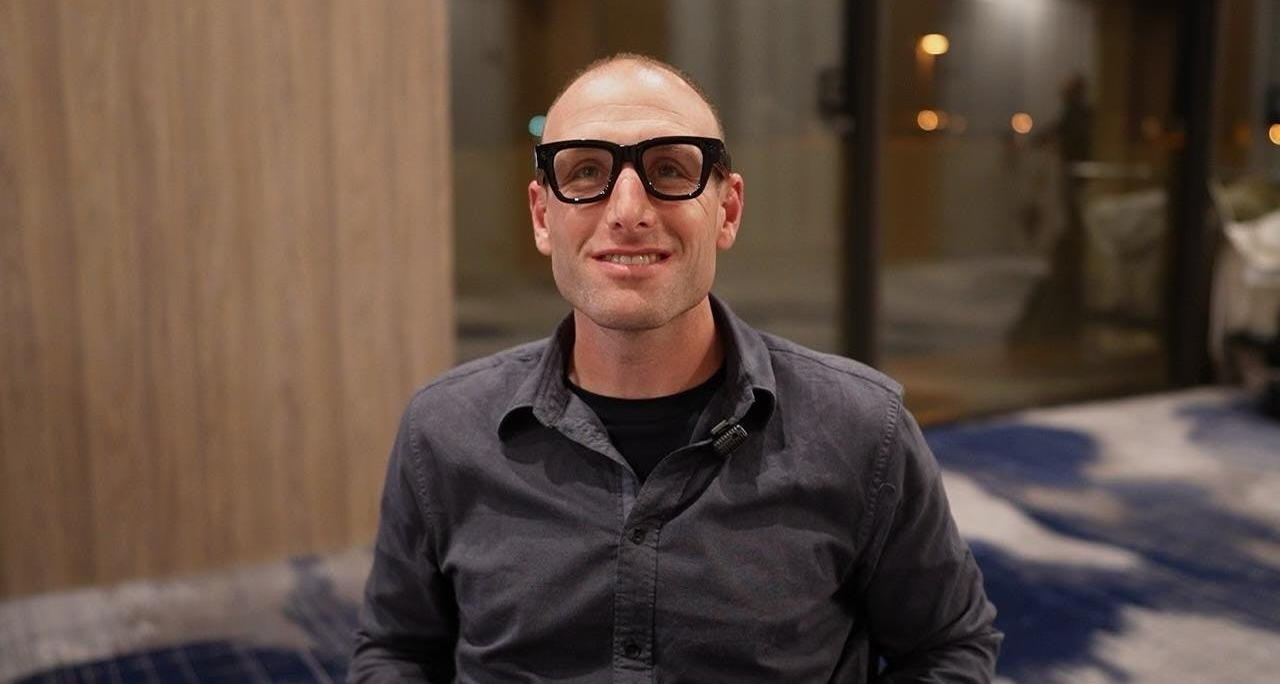
Alex Hamil, head of wearables at Meta
When Alex Hamil, head of wearables at Meta, walked on stage at IAB’s Annual Leadership Meeting, he wasn’t there to sell the room a shiny new gadget. He was there to make a quieter – and more unsettling – point: the most important screen in advertising’s future might not be a screen at all.
We caught up with Hamil moments after his talk, just as Meta was also rolling out its new Super Bowl campaign for Oakley Meta glasses – a slick, high-energy statement that positions smart eyewear not as novelty tech, but as performance equipment for a new era. The timing felt deliberate. Wearables, after years of promise and prototypes, are edging into something more real.
Hamil’s starting point is simple enough. “We went from the physical world to laptops and phones,” he said. “The next level is digital content that lives with you in the physical world – not something you have to look down at.”
That shift from handheld screens to face-worn interfaces underpins Meta’s wearables strategy. Not full sci-fi augmented reality just yet, but something that can scale faster and feel normal sooner.
“AI feels like the thing that should be ubiquitous before full augmented reality,” Hamil explained. “And glasses are the form factor where that can happen.”
Hamil spent years inside Meta’s ads business before moving into wearables – a jump that might sound odd until you hear how Meta thinks about talent.
“We believe you can learn domains quickly,” he said. “You bring what you know – how you build software, how you scale products, how you partner – and apply it somewhere new.”
That mindset matters when you’re overseeing devices like Meta’s Orion prototype, packed with custom waveguides, micro-LED projectors and serious silicon engineering.
“That took me a while to get up to speed on,” he admitted. “But a lot of what matters is universal.”
Advertisement
During our conversation, Hamil was wearing the Meta Ray-Ban Display Glasses, the most advanced consumer model Meta has released so far.
These aren’t just camera glasses. They include a small, high-resolution monocular display on the right-hand side, bright enough to read outdoors, paired with photochromic lenses that darken in sunlight. Less than 1% of light leaks outward, meaning only the wearer can see what’s on screen.
Control comes via a subtle Meta wristband, allowing users to swipe and tap without touching the frames. Hamil had just used them on stage as a discreet teleprompter – a quietly impressive demonstration of how these devices remove friction from everyday tasks without drawing attention to themselves.
Hamil’s appearance at IAB ALM also coincided with one of Meta’s most visible statements yet about where wearables are heading: the launch of Oakley Meta’s Super Bowl campaign, which he referenced during his session with the IAB audience.
The campaign, built around the line ‘Athletic Intelligence Is Here,’ positions Meta’s AI-powered glasses not as experimental tech but as performance equipment. Less Silicon Valley novelty and more elite sports kit.
Running as two placements during the game, the film features a cast that deliberately blurs sport, culture and creator influence, including Spike Lee, Marshawn Lynch, iShowSpeed, PGA Tour breakout Akshay Bhatia and Olympians Sky Brown, Kate Courtney and Sunny Choi. Set to Travis Scott’s Hyaena, it frames the glasses as something that enhances instinct, awareness and decision-making in high-pressure moments.
For Hamil, the Super Bowl isn’t just about reach – it is about reframing the category.
Wearables, he suggested, need to be understood as tools that work in motion, in real environments, not as devices that pull you out of the moment. That philosophy ran through both the campaign and his ALM remarks: technology should “flow inside the action,” not act as a pause button.
It also helps explain why Meta is leaning into sport and performance culture as an early proving ground. If glasses can earn their place there, where utility is obvious and friction is unacceptable, the case for broader, everyday adoption becomes much easier to make.
Meta’s product philosophy has been deliberately grounded. “The two things people do the most are talk on the phone and listen to music,” Hamil said. “Then, it is capture moments.”
So that’s where the glasses began: calls, music, photos and video – all hands-free, wrapped in frames that still look like normal eyewear. Even without the tech, they pass as decent sunglasses.
From there, AI becomes the multiplier. Hamil pointed to examples like Disney theme parks, where glasses could proactively flag shorter queues based on your preferences without you having to prompt anything.
“That’s the ambition,” he said. “Context-aware AI that gives you the right information at the right moment and all you have to do is say ‘yes’ or ‘no.’”
Another example is fixing a car battery while step-by-step instructions float in your field of view, leaving both hands free. “That’s where this becomes really common,” he said.
The obvious question is, is Meta trying to replace the smartphone?
“We’re pretty bullish,” Hamil said, with a caveat. Different devices will continue to do different jobs, but glasses allow you to stay present rather than constantly dipping into a screen. “You don’t have to disconnect from the moment to get information or capture what’s happening.”
The hard parts aren’t technical any more. They’re social and physical: comfort, style, prescription lenses, distribution.
“We’ve got to get the hardware right – how they look, how they feel – and then keep adding value.”
Advertisement
That thinking also explains Meta’s broader wearables philosophy. The company has explored everything – watches, headphones, even hats (a topic that perked me up immediately) – but Hamil is skeptical of anything unfamiliar.
“We strongly believe in familiar form factors,” he said. “Years of human evolution have already told us what’s comfortable.”
His test is brutally practical: how many people wear it, how long they wear it and what functionality you can realistically deliver.
“Everyone wears shoes,” he laughed, “but that doesn’t make them a great AI device.”
Implants? Not anytime soon. “Glasses are low commitment,” he said. “Implants require enormous value to justify.”
As cameras get smaller and more discreet, privacy becomes an unavoidable concern. Meta has leaned into visible signals rather than hiding them.
The recording LED on its glasses is brighter and larger than before and deliberately placed opposite the camera. There’s also a light sensor that prevents recording if it can’t detect ambient light.
“It’s about making people around you comfortable,” Hamil said, not just the wearer.
Advertisement
Given Meta’s business model, the biggest unanswered question is commercial. If glasses really are the next interface, advertising will inevitably follow. But Hamil was clear that this is not imminent.
“There’s no advertising to do until you have scale,” he said. “From a format and ROI perspective, it just doesn’t make sense yet.”
That said, Meta is an advertising-funded company and no one is pretending this ecosystem won’t eventually need to monetize. The crucial point is, how?
This won’t look like banners floating in mid-air. The opportunity skews towards contextual, physical-world media – much closer to retail and commerce media than traditional brand advertising.
Early experiments already hint at this. In select cities, Meta is testing in-store experiences that help users understand where they are and what’s around them. Extend that logic slightly and you get product discovery, visual search, wayfinding and comparison – all without pulling out a phone.
“You see something in the physical world and that’s what the AI understands,” Hamil said. “Then there’s what it looks like once you’re actually using it. That gap is a really interesting use case.”
For retailers, this looks like assistance rather than interruption. For brands, it is influence tied to intent, place and moment. For advertisers, it’s closer to commerce media than classic display.
For Hamil, that shift from reactive to proactive AI is crucial. It’s also a glimpse of how wearables quietly move from novelty to necessity: not by overwhelming users with features, but by removing friction from real, physical experiences – whether that’s navigating a theme park, a store or, eventually, any complex environment where your hands are busy and your attention matters.
None of this is happening overnight. Meta is still focused on adoption, comfort and habit-building – particularly cracking prescription lenses and distribution at scale.
But the trajectory is clear. If phones trained us to live inside screens, Meta’s wager is that AI-powered glasses pull digital utility back into the physical world.
Advertising won’t disappear – but it will have to behave differently. Less shouting. More helping. Less impressions. More intent.
Which, whether Meta planned it this way or not, sounds an awful lot like where commerce media is heading anyway.
Meta
Meta builds technologies that help people connect, find communities and grow businesses.
Advertisement
Why Meta thinks glasses, not phones, are the next great advertising surface – The Drum
Related Posts
 fev 4, 2026
 fev 4, 2026
 fev 4, 2026
