
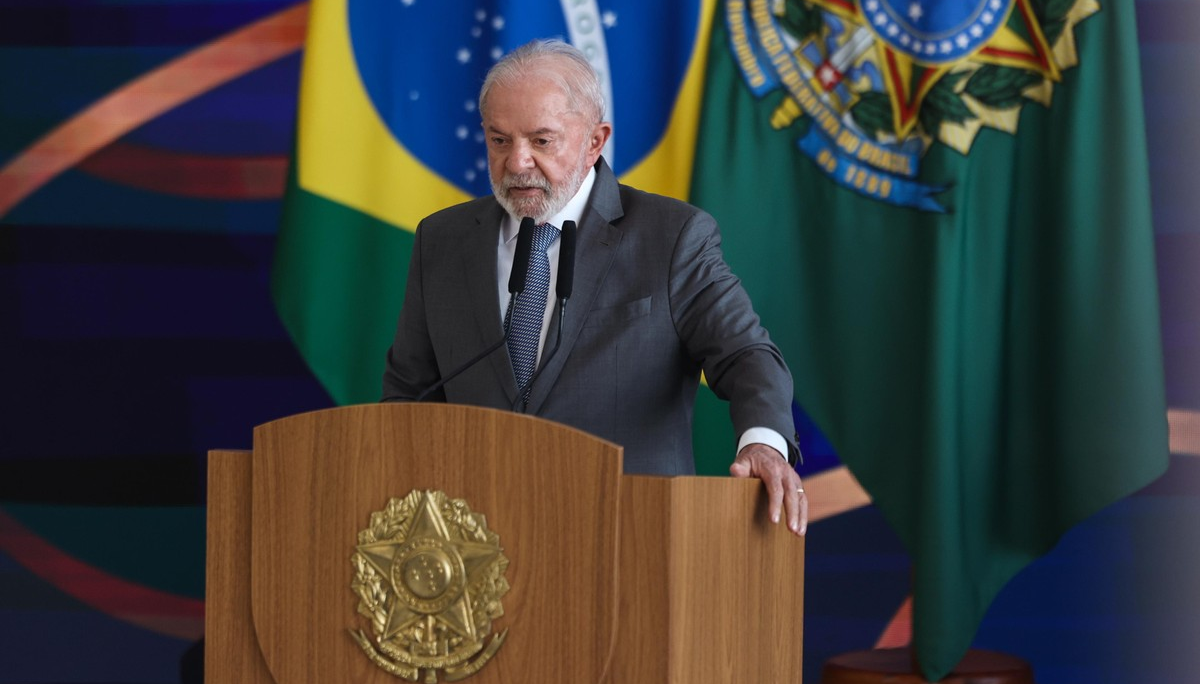
President Lula is expected to give final approval on Wednesday (13) to a bill regulating and sanctioning big techs for disseminating criminal content. The proposal will then be sent to Congress. In the afternoon, the president will meet with ministers to reach a consensus within his administration and finalize the text.
According to Mr. Lula, the Chief of Staff Office has been working on the draft for about two months. “Tomorrow [today], at 3 p.m., the [social media regulation] text will be on my desk to settle disagreements among ministers before sending it to Congress,” he said in an interview with BandNews FM radio station on Tuesday night (12).
The president argued that those who oppose social media regulation are precisely “the ones who make a lot of money from it.” “Free speech does not mean promoting hatred online,” he said. “If any foreign [social media] company comes to Brazil, it will be regulated,” Mr. Lula added.
Earlier in the day, Chief of Staff Rui Costa said it is necessary to regulate, oversee, and punish not only those who post such content but also those who enable its dissemination. “The Brazilian government supports the regulation and oversight of these companies, which generate billions in profits, often at the expense of people’s physical and psychological integrity,” he told Rádio Alvorada FM in Guanambi (Bahia) on Tuesday (12).
According to Mr. Costa, “more than ever, Brazil needs to regulate, oversee, and punish” these practices. In his view, regulating social media is “a matter of security.”
The topic regained prominence in Brazil after a video by YouTuber Felipe Bressanim, known as Felca, highlighted the risks of what he called the “adultization” of children on social media. The video’s reach prompted Lower House Speaker Hugo Motta (Republicans) to announce plans to prioritize bills aimed at protecting children on online platforms.
Mr. Motta’s move came just days after a pro-Bolsonaro mutiny disrupted proceedings in the Chamber. The speaker is now betting on a “positive agenda” such as protecting children and adolescents online to calm tensions in Congress and advance the legislative agenda. He called the issue “urgent,” announced the creation of a working group to discuss it, and said there are more than 60 bills already filed in the Chamber on the subject. The group is expected to present a draft within 30 days.
Still, the matter may face resistance from the opposition, potentially undermining Mr. Motta’s efforts to ease tensions. The Lower House has struggled to address issues affecting digital platforms. Under the leadership of Arthur Lira (Progressive Party), lobbying by big techs blocked the progress of Bill 2630/2020, which ended up shelved. Another contentious debate—driven by platform interests—was the streaming bill regulating Video on Demand (VoD). Liberal Party lawmakers also ran aggressive campaigns against such proposals.
In the Senate, the debate spurred opposition Senators Damares Alves (Republicans) and Jaime Bagattoli (Liberal Party) to gather 70 signatures in support of creating an Investigative Parliamentary Committee (CPI) into the sexualization of children, according to their offices. Despite being led by opposition lawmakers, the initiative has united legislators aligned with both former President Jair Bolsonaro and President Lula. Both Senate opposition leader Rogério Marinho (Liberal Party) and government leader Jaques Wagner (Workers’ Party) signed on, according to the published list.
Reaching the necessary number of signatures does not automatically trigger the CPI, which is composed solely of senators. The decision depends on Senate President Davi Alcolumbre (Brazil Union) reading the request in a floor vote.
Although the matter has dominated Brazil’s political agenda in recent days, crimes against children and adolescents have already been addressed by the Federal Supreme Court (STF). In June, the Court broadened the scope of social media liability for user-generated content, ruling that child pornography and “serious crimes against children and adolescents” must be removed immediately by platforms, without the need for a court order or notification. Big techs can face civil penalties for failing to take such content down.
In practice, the ruling requires social media companies to implement active monitoring to curb users’ criminal behavior online. Supreme Court justices consulted by Valor said the bills under discussion in Congress are less stringent than the Court’s June decision. Still, they see legislative initiatives as welcome tools to prevent violations of children’s and adolescents’ rights on social media.
This article was translated from Valor Econômico using an artificial intelligence tool under the supervision of the Valor International editorial team to ensure accuracy, clarity, and adherence to our editorial standards. Read our Editorial Principles.
More than 217,000 bettors have requested self-exclusion from betting sites on government platform
The event is expected to generate R$14.48 billion in tourism revenue for the country, according to a study by the National Confederation of Commerce
Innovation spending estimated at $1.7 trillion in 2025 could climb to $2.5 trillion this year
Investigation comes as one-third of programs are deemed unsatisfactory in federal exam
CB Bioenergia, based in the city of Santiago, began operations this month, while the Be8 plant—backed by an investment of R$1 billion—is under construction in Passo Fundo
Fourth-quarter performance and preliminary full-year results point to resilient demand, but slower sales velocity raises concerns
Precedents are in favor of upholding decisions by regulatory bodies, and there is an understanding that, given the magnitude the case has reached, there would be no room for a reversal
Association of producers projects a crop of 3.829 million tonnes
With four nominations, director Kleber Mendonça Filho’s film equals achievements won by Brazilian cinema with Kiss of the Spider Woman (1985) and City of God (2004)
Allocation trend stands at 5.3%, well below 10-year historical average of 6.7%
Government drafts bill to regulate social media, sanction big techs – Valor International
Related Posts
 jan 22, 2026
 jan 22, 2026
 jan 22, 2026
