
Advertisement
Member article
This content is produced by a member of The Drum Network, a paid-for membership club for CEOs and their agencies who want to share their expertise and grow their business.
January 27, 2026 | 8 min read
Listen to article 4 min
For the past two decades, digital advertising has been built around interruption. Search ads intercept intent. Social ads interrupt attention. Display fills the gaps. The introduction of paid ads into OpenAI’s ChatGPT platform signals something structurally different: advertising designed to sit inside a trusted decision-making environment, not alongside content, feeds, or results pages. That shift matters far more than the formats themselves.
Over the coming weeks, paid ads will begin appearing inside ChatGPT for US-based users on free and Go tiers. At the same time, Google is signaling its own direction of travel, with new ad formats and direct offers designed to sit inside AI Mode and Gemini as people research and shop.
Taken together, these announcements point to something larger than new placements. They mark a shift in where commercial influence is allowed to appear during decision-making.
ChatGPT is not positioned as media. It’s positioned as a utility. People use it to think, decide, plan, and learn. That’s why ChatGPT has been so explicit about protecting answer independence, conversation privacy, and user control as it prepares to test ads for free and Go users in the US.
Industry commentary has been quick to note that these ads are impression-based rather than click-driven, prioritizing visibility within answers over traffic generation. This alone sets them apart from traditional search advertising.
This isn’t simply a brand safety stance. It is a commercial necessity.
The moment users suspect that answers are being shaped by commercial influence, the product collapses. Unlike search, where users accept ranked results and paid placements, conversational AI is experienced as advisory. It feels closer to asking a trusted colleague than browsing a results page.
That distinction forces a different advertising logic.
Marketers will instinctively try to map ChatGPT ads onto familiar models: keywords, intent capture, last-click attribution. That will miss the point.
Ads are planned to appear at the bottom of responses, clearly separated from answers, only when there is a relevant product or service connected to the conversation. That framing positions advertising as an optional extension of usefulness, not the driver of the interaction.
As analysts have already pointed out, AI-generated answers are becoming a new visibility layer rather than a traffic channel.
In other words, the ad is not there to win the click. It’s there to support a decision already forming.
That changes what ‘good’ looks like. Creative will matter more than bidding. Relevance will matter more than reach. Brands that add clarity will outperform brands that add noise.
One of the most under-discussed implications is how brutally conversational environments surface brand weakness.
In a feed, brands rely on repetition, familiarity, and visual dominance. In search, they rely on proximity to keywords. In ChatGPT, a brand can be questioned immediately.
If an ad allows users to ask follow-up questions directly, claims will be interrogated. Pricing, ethics, delivery, sourcing, policies, and differentiation all come under scrutiny in real time.
This aligns with a wider industry view that brands which feel native, helpful and genuinely relevant outperform those built on inflated promises or aggressive promotion. In conversational environments, brand, product, and experience are no longer separable.
It’s tempting to frame ChatGPT ads as a future challenger to Google Search advertising. That comparison is incomplete.
Search monetizes expressed intent. ChatGPT monetizes assisted intent. It sits earlier in the thinking process, where users are shaping preferences, trade-offs and options before they ever decide to ‘search.’
That puts it in competition with content, reviews, comparison sites, influencers, and brand storytelling more than classic PPC.
Notably, Google Gemini is currently positioned as an ad-free product layer, reinforcing the idea that AI systems are being framed as decision-support environments rather than monetized surfaces, at least for now.
At the same time, Google’s recent announcements around AI-native shopping and Direct Offer formats show that commercial visibility is being pulled closer to the research phase, not just the point of purchase.
For brands, this raises a strategic question: are you visible only when someone asks for you, or are you present when someone is deciding what ‘good’ looks like?
OpenAI’s insistence that ads will not influence answers and that conversations are not shared with advertisers is not just a privacy commitment. It reframes trust as infrastructure.
In most platforms, trust is a reputational concern. In ChatGPT, it’s a dependency. Lose it and the entire system fails, which forces marketers to rethink how media value is measured in the first place.
Scale and efficiency still matter, but alignment with user expectations matters more. Ads that feel extractive will not just underperform. They risk damaging the environment itself.
That creates an unusually strong incentive for restraint.
Even before ads launch externally, there are clear implications for marketing strategy.
First, brand clarity matters more than optimization tricks. If a brand cannot explain itself clearly in plain language, it will struggle in conversational environments.
Second, authority signals beyond ads become more important. The way a brand appears in organic conversations, summaries, and recommendations will shape how any paid presence is interpreted.
Third, teams should expect slower feedback loops but higher signal quality. Fewer impressions, fewer clicks, but richer insight into what actually influences decisions.
This reinforces a broader trend that marketing is moving from visibility, exposure, and persuasion to usefulness, assistance, and participation.
Early preparation matters more than early spend.
Despite the attention, much of ChatGPT’s advertising remains a mystery.
There’s no confirmed launch timeline outside the US. There is no clarity on access, buying models, pricing, or how brands will be onboarded. Even the role this plays alongside existing PPC platforms is still being tested rather than promised.
This is not a switch being flipped on performance marketing, but an experiment in how commercial visibility fits inside AI-assisted decision making, particularly for PPC teams used to operating at the point of demand capture.
The focus should not be on reallocating budgets or chasing a new placement. It’s about recognizing that influence is expanding beyond clicks and keywords, and that paid and organic search are moving closer together conceptually.
In that sense, the future of PPC is not disappearing, but it is being stretched. Search advertising still captures demand. AI environments increasingly shape it.
The winners will be the teams that prepare for that overlap early, without rushing to spend before the model has proven its value.
OpenAI has confirmed that ads are not live yet and that the early phase will prioritize learning over scale. That caution is sensible. Introducing advertising into a trusted assistant is one of the highest-risk moves in modern platform design.
If it works, it could reset expectations for what advertising is allowed to be, shifting it from interruption to something that earns its place within the thinking process.
For those brands still optimizing for attention alone, it’ll feel uncomfortable very quickly.
And that may be the point.
Advertisement
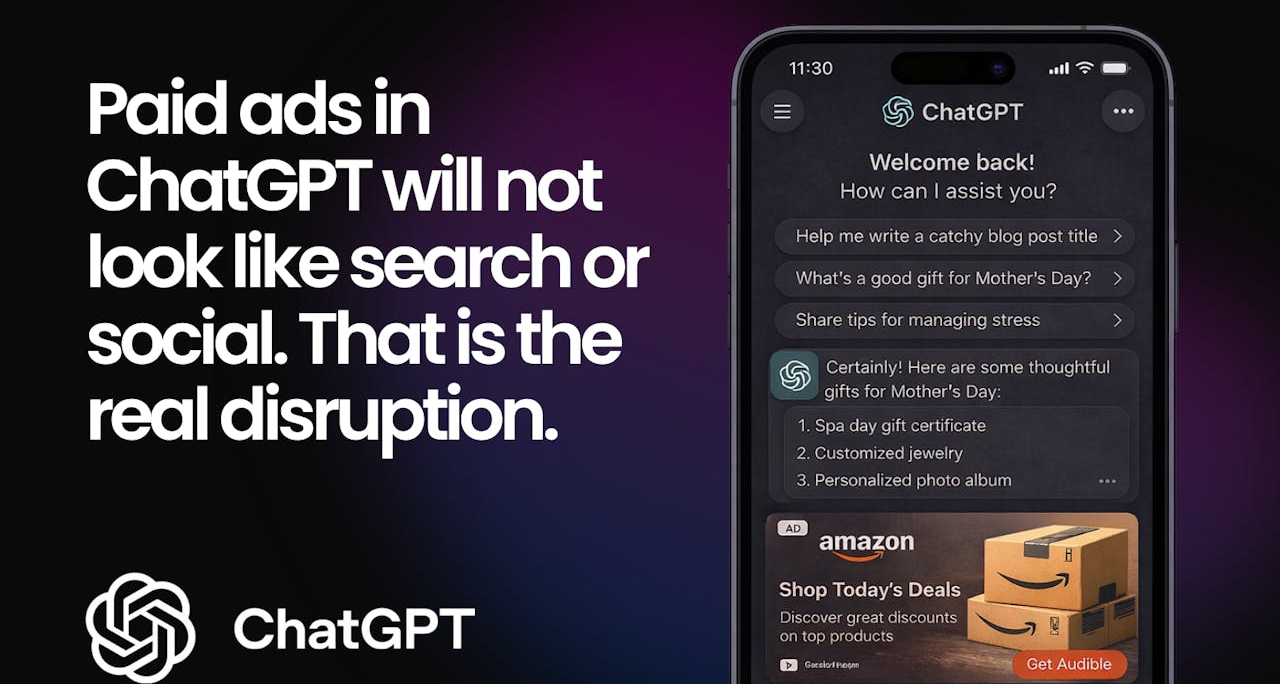
Paid ads in ChatGPT will not look like search or social. That’s the real disruption – The Drum
Related Posts
 jan 28, 2026
 jan 28, 2026
 jan 28, 2026