
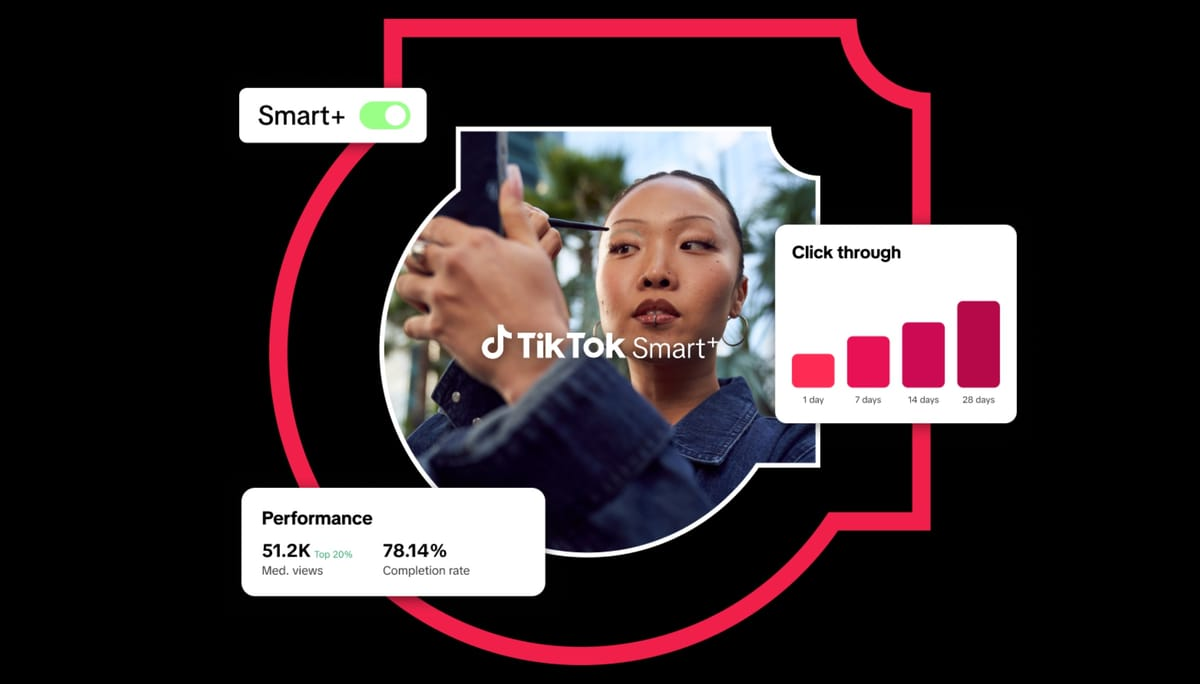
TikTok upgrades Smart+ with creative automation, ad preview tools, and efficiency features that address advertiser complaints about automated campaign control.
TikTok this week introduced substantial upgrades to Smart+, the advertising automation platform that the company first launched in October 2024 with promises of simplified campaign management across targeting, creative, and budget optimization. The enhancements address persistent advertiser concerns about visibility and control within automated advertising systems, bringing Smart+ closer to feature parity with competing platforms from Meta and Google.
The upgrades arrive as automation has become the dominant paradigm across digital advertising platforms. Major platforms merged behind AI agents throughout 2025, with Google marking its 25-year evolution from manual campaigns to AI-powered optimization, Amazon launching its Ads Agent for natural language campaign management, and Meta’s Advantage+ suite driving 22% return on ad spend improvements alongside documented brand safety failures.
TikTok’s Smart+ updates center on three areas: creative automation through Auto-select, operational visibility through ad preview capabilities, and campaign management efficiency tools that bring automated campaigns closer to manual campaign workflows. The timing reflects competitive pressure as platforms race to balance automation efficiency with advertiser demands for transparency and control.
Creative for Smart+ introduces Auto-select, currently available exclusively for Smart+ App campaigns. The feature scans existing advertisements and eligible creator content from TikTok One, then recommends high-performing creative assets for brands and campaign objectives. According to the announcement, all creator content surfaced through Auto-select comes pre-approved for advertising use, with TikTok managing creator payment and logistics at no additional cost to advertisers.
The creator content integration distinguishes TikTok’s automation approach from competitors. While Google’s Asset Studio with Imagen 4 generates synthetic creative assets and Amazon’s Video Generator creates product demonstrations from URLs, TikTok’s Auto-select leverages authentic user-generated content that historically drives higher engagement on the platform.
The creative automation arrives nine days after TikTok integrated generative AI into its Video Editor tool within TikTok Ads Manager, demonstrating accelerated deployment of AI capabilities across the advertising platform. Both implementations address creative fatigue – a persistent challenge where repeated exposure to identical advertisements reduces engagement rates and campaign performance.
TikTok Marketing Science’s Global Creative First Study conducted by Ipsos in 2022 revealed that 79% of TikTok users find platform-specific creative assets engaging, with 60% of users exposed to these advertisements indicating purchase intent within 3-6 months. The CPG Sales Lift Meta-Analysis from 2021-2022 suggests maintaining 5-7 creative variations within each ad group, with weekly updates recommended to maximize return on ad spend.
Auto-select addresses these requirements through automated creative selection rather than requiring advertisers to manually identify and rotate performing assets. The system continuously evaluates creative performance against campaign objectives, surfacing new combinations as engagement patterns shift.
Smart+ now enables advertisers to preview every possible creative combination before advertisements launch, directly within TikTok Ads Manager. According to the announcement, this upgrade provides full visibility into what will actually run, making it easier to spot errors, make changes, streamline creative approvals, and accelerate iteration.
The preview capability addresses a fundamental tension in automated advertising: efficiency gains from algorithmic creative assembly versus advertiser needs for brand safety verification before spend begins. Previous Smart+ implementations generated creative combinations algorithmically without preview options, forcing advertisers to trust the system’s judgment or sacrifice automation benefits through manual creative management.
The preview functionality particularly matters for brands managing regulatory compliance, trademark usage, or sensitive positioning requirements. Financial services advertisers face strict disclosure requirements. Healthcare companies must verify medical claims accuracy. Consumer brands protect against off-brand messaging that could damage equity built through years of marketing investment.
Meta’s Advantage+ campaigns have faced documented criticism around creative disasters where automated systems generated brand-damaging combinations, including Valentine’s Day incidents with 10x cost inflation and budget catastrophes depleting entire monthly allocations within hours. The incidents underscore why preview capabilities represent essential rather than optional features in automated advertising platforms.
TikTok’s preview implementation enables granular review of text, image, and video combinations generated by the platform’s creative assembly system. Advertisers can identify problematic pairings, make corrections, and approve campaigns with confidence that brand guidelines will be maintained throughout automated optimization.
Smart+ efficiency tools received upgrades including duplication, draft mode, automated rules, and bulk editing – capabilities advertisers rely on in manual campaigns. According to the announcement, these features bring familiar control to automated workflows, reducing manual work while improving day-to-day execution.
The efficiency upgrades acknowledge that most advertisers operate hybrid portfolios combining manual and automated campaign types. Campaign duplication enables rapid testing of different targeting parameters or budget levels without rebuilding campaign structures from scratch. Draft mode allows preparation of campaigns for future launches without immediate activation. Automated rules implement condition-based adjustments – pausing campaigns when cost per acquisition exceeds thresholds or increasing budgets when return on ad spend surpasses targets.
Bulk editing addresses scale challenges facing advertisers managing dozens or hundreds of campaigns. Rather than editing individual campaigns sequentially through multiple interface interactions, bulk editing enables simultaneous modifications across campaign sets through spreadsheet-style interfaces or API implementations.
These workflow features reflect broader platform recognition that automation requires supporting infrastructure beyond algorithmic optimization. Google introduced text guidelines for Performance Max and AI Max campaigns in September 2025, enabling advertisers to specify term exclusions and messaging restrictions using natural language. Campaign-level negative keywords arrived through Google Ads Editor 2.10 on July 8, 2025, addressing longstanding limitations where advertisers could not exclude irrelevant search terms directly at the campaign level.
The pattern demonstrates that automated advertising platforms require ongoing feature development to address control gaps identified through advertiser feedback. Initial automation implementations prioritize algorithmic optimization, with subsequent releases adding transparency and override mechanisms as adoption reveals workflow friction points.
Smart+ allows configuration across targeting, creative, placement, and budget parameters. Targeting enables location, age, and language specification, with optional custom audiences or interest targeting to guide automatic systems, or manual targeting for complete control. Budget management supports automated Campaign Budget Optimization or advertiser-set budgets and bidding strategies for each ad group.
Placement control merged with the brand safety module, with Automatic Placement expanding reach while maintaining safety parameters. Campaign structure supports up to 30 ad groups per campaign, 30 asset groups per ad group, and 50 creatives per asset group, enabling text pairing with specific creatives and traffic direction to multiple URLs.
Reporting capabilities provide enhanced creative-level analysis across three dimensions: Creative, Text, and Enhancement. Ad-level operations enable performance visibility and streamlined management at both asset group and individual creative levels. The reporting structure addresses a persistent automation challenge – understanding why systems make specific decisions and identifying optimization opportunities.
Reddit’s Max campaigns introduced similar transparency features in December 2025, including Top Audience Personas that identify prevalent persona types within campaign audiences with labels such as “new parents” or “ambitious home cooks” alongside performance metrics. Cross-campaign creative asset reporting provides performance data for individual headlines, images, and videos across multiple campaigns.
The transparency approach contrasts with earlier automation implementations that operated as black boxes, providing limited visibility into optimization decisions. Meta’s Advantage+ campaigns traditionally limited visibility, while Google’s Performance Max faced persistent “black box” concerns that prompted channel performance reporting as a direct response to advertiser feedback.
Smart+ powers all performance-related objectives, from driving sales and traffic to app promotion and quality lead generation. Smart+ Sales Campaigns drive lower-funnel actions, with Smart+ Catalog Ads specifically designed for advertisers with product catalogs covering commerce, hotels, flights, or destinations.
Smart+ Catalog Ads pair end-to-end campaign automation with catalog intelligence, converting static catalogs into optimized shoppable advertisements driving sales to websites or applications. According to the announcement, closed beta tests showed advertisers achieved 36% cost per acquisition reduction versus manual campaigns. The system engages high-intent shoppers through daily budgets ensuring products remain top-of-mind, personalizes advertisements by connecting catalogs to creative content matching shopper preferences, and optimizes across both website and application conversions.
The catalog advertising capability positions TikTok competitively against established e-commerce advertising platforms. Amazon’s Sponsored Products video format launched in November 2025 with interactive feature thumbnails, demonstrating 9% click-through rate increases aggregate across campaigns with video. Google’s Performance Max campaigns received more than 90 quality improvements during 2025, driving conversion increases exceeding 10%.
Smart+ App Campaigns introduce flexible bidding strategies aligning campaigns to specific goals across the app marketing lifecycle, whether focused on maximizing installs or optimizing for outcomes like return on ad spend. Advertisers can leverage Target ROAS and Cost Cap to deliver precise optimization and control achieving ROAS and cost per acquisition targets efficiently. Near real-time conversion reporting for iOS provides visibility into performance, addressing measurement challenges that have plagued iOS advertising since Apple implemented privacy restrictions.
Smart+ Lead Generation delivers both quality and quantity through multiple pathways including Instant Forms, Web Forms, Messaging, and Call Ads, along with specialized formats like Automotive Ads. Deep funnel optimization increases lead quality and deeper-funnel conversions, while goal-based bidding solutions such as Cost Cap allow businesses to align spend with performance goals, ensuring efficiency at scale.
Lead generation represents a challenging objective for automated platforms. Facebook advertising benchmarks released September 2025 revealed lead generation campaigns experienced 21% cost per lead increases to $27.66, while traffic campaigns showed stronger efficiency metrics. The divergent performance demonstrates that automation effectiveness varies substantially by campaign objective and platform capability.
Smart+ now features Symphony Automation, bringing TikTok’s generative AI tools directly into Smart+ workflows. The integration allows advertisers to generate fresh assets, enhance existing creative, and maintain campaign performance without leaving the Smart+ environment.
Symphony Automation currently offers two solutions: Recommended Creatives and Automatic Enhancements. Recommended Creatives provides recommendations on which assets from advertiser libraries will perform best against campaigns, while also generating TikTok-ready videos from product URLs to combat creative fatigue with minimal effort. Automatic Enhancements optimizes existing assets through single-click improvements including video and image quality enhancement, resizing for TikTok’s vertical format, music or hook refreshes, and content translation and dubbing into 50+ languages.
The generative AI integration builds on TikTok Symphony, the comprehensive suite launched June 2024 that includes Symphony Assistant for brainstorming support, best practice recommendations, trend identification, and inspiration. Symphony Assistant leverages a knowledge base of TikTok-specific creative insights delivering tailored suggestions for optimizing organic and paid content.
The video generation capabilities compete directly with emerging creative automation platforms. MNTN launched QuickFrame AI in October 2025, combining Google’s Veo, ElevenLabs, and Stability AI to generate complete commercials from URLs in approximately 12 minutes. The system achieved turnaround times drastically shorter than traditional video production, which typically requires weeks for concept development, scripting, filming, and post-production.
Adobe expanded GenStudio for Performance Marketing throughout 2025, adding custom AI models and direct integrations with Amazon Ads and Innovid. The platform enables teams to assemble, activate, and optimize experiences across major advertising channels from unified interfaces, demonstrating industry-wide movement toward integrated creative and advertising platforms that merge previously separate workflows.
TikTok’s Smart+ enhancements arrive amid comprehensive platform automation across digital advertising. The competitive environment demonstrates industry consensus that AI-powered automation represents the future of campaign management, despite ongoing debates about transparency, control, and performance consistency.
Meta’s Advantage+ suite now handles targeting, creative optimization, placements, and budget allocation with minimal human oversight. The company reported $20 billion annual run rate and 22% ROAS improvements, though prominent advertising experts warned of “brand damage at scale” citing demographic mismatches, budget catastrophes, and creative disasters. The tension demonstrates measurable efficiency gains for many advertisers while simultaneously raising concerns about transparency and control essential to protecting brand identity.
Google Performance Max represents the closest parallel to Smart+ and Advantage+, launched in 2021 and becoming mandatory by 2022 when Google retired Smart Shopping and Local campaigns. PMax runs advertisements across Search, Shopping, YouTube, Gmail, Display, and Discover with automated targeting, placements, and creative assembly. The platform received continuous improvements throughout 2025, including Asset Studio for creative production, text guidelines for brand safety, and channel performance reporting addressing persistent transparency concerns.
Amazon merged DSP and Ads Console into unified Campaign Manager in December 2025, pairing platform consolidation with agentic AI tools that generate creative, build campaigns, recommend targeting, and write Amazon Marketing Cloud queries using natural language. The integration represents Amazon’s most significant advertising platform reorganization since launching its DSP, collapsing historically distinct buying channels into unified infrastructure.
TikTok’s president of global business solutions Blake Chandlee stated in October 2024 that “with the advent of Smart+, the gap will close almost entirely with Meta,” positioning TikTok’s automation on parity with industry benchmarks. Early results showed promise – Ray-Ban’s beta campaign achieved 50% cost per acquisition reduction – though TikTok’s smaller scale limits market impact. The platform expects $28.42 billion in 2025 advertising revenue versus Meta’s $173.92 billion.
TikTok’s differentiation centers on creative-first environment and younger demographics. The platform emphasizes authentic, entertainment-focused content over polished advertising, with Symphony AI assisting script writing and video production specifically for TikTok’s vertical video format. This positioning contrasts with platforms prioritizing search intent, shopping behavior, or professional networking contexts.
The Smart+ upgrades reflect broader recognition that automated advertising requires continuous feature development addressing control gaps identified through advertiser feedback. Initial automation implementations prioritize algorithmic efficiency, with subsequent releases adding transparency and override mechanisms as adoption reveals workflow friction points.
The preview functionality matters most for brands managing regulatory compliance, trademark usage, or positioning requirements where automated creative assembly risks violations. Financial services advertisers verifying disclosure accuracy, healthcare companies confirming medical claims, and consumer brands protecting equity built through marketing investment require visual confirmation before spend begins.
The efficiency tools enable hybrid portfolios combining manual and automated campaign types. Most advertisers operate across multiple campaign structures, requiring workflow consistency between manual campaigns offering granular control and automated campaigns delivering algorithmic optimization. Duplication, draft mode, automated rules, and bulk editing bring automated campaigns closer to manual campaign capabilities.
The creator content integration through Auto-select represents TikTok’s distinctive automation approach, leveraging authentic user-generated content rather than synthetic generation. The strategy aligns with platform strengths around organic creator content while addressing creative production bottlenecks facing advertisers without in-house video capabilities or agency partnerships.
The competitive environment suggests automation has become table stakes rather than differentiation. Every major platform offers AI-powered campaign automation, with competition centering on transparency, control mechanisms, and performance consistency rather than automation existence. Yahoo DSP launched agentic AI capabilities in January 2026, enabling advertisers to automate campaign setup, troubleshooting, and optimization through natural language. Reddit’s Max campaigns launched in December 2025, achieving 17% cost reductions through AI optimization.
The Smart+ enhancements position TikTok competitively within this automation landscape, addressing advertiser concerns about visibility and control while maintaining algorithmic efficiency benefits. The platform’s creative-first positioning and authentic content emphasis provide differentiation opportunities as automation capabilities converge across competitors.
For performance marketers managing multi-platform campaigns, the Smart+ upgrades reduce friction when expanding TikTok investment. Preview capabilities address brand safety verification requirements. Efficiency tools enable portfolio management at scale. Creator content integration provides creative asset access without production bottlenecks. The combination makes Smart+ more viable for sophisticated advertisers requiring transparency alongside automation.
Who: TikTok introduced upgrades to Smart+, the advertising automation platform serving performance marketers managing campaigns across app promotion, e-commerce sales, traffic generation, and lead generation objectives. The enhancements affect advertisers using TikTok Ads Manager globally, with Auto-select creative automation currently available exclusively for Smart+ App campaigns. Creator content sourced through TikTok One provides pre-approved assets with TikTok managing payment and logistics.
What: The Smart+ upgrades encompass three primary areas: Creative for Smart+ featuring Auto-select that scans existing advertisements and eligible creator content to recommend high-performing creative assets; ad preview capabilities enabling advertisers to review every possible creative combination before launch directly within TikTok Ads Manager; and efficiency tools including duplication, draft mode, automated rules, and bulk editing bringing manual campaign capabilities to automated workflows. Symphony Automation integrates generative AI tools providing Recommended Creatives and Automatic Enhancements for asset generation and optimization.
When: TikTok announced the Smart+ upgrades on January 21, 2026, building on the platform’s initial Smart+ launch from October 2024 and recent Video Editor AI integration from January 9, 2025. The enhancements arrive during a period of intensive platform automation competition, with Yahoo DSP launching agentic AI on January 6, 2026, following Amazon’s Campaign Manager consolidation in December 2025 and Reddit’s Max campaigns in December 2025.
Where: The upgrades apply to Smart+ campaigns within TikTok Ads Manager, accessible globally across markets where TikTok advertising operates. Auto-select creative automation currently limits availability to Smart+ App campaigns, though the ad preview and efficiency tools apply across all Smart+ campaign types including Sales Campaigns with Catalog Ads, App Campaigns, and Lead Generation Campaigns. Symphony Automation operates within Smart+ workflows without requiring separate platform access.
Why: The upgrades address persistent advertiser concerns about visibility and control within automated advertising systems. Ad preview eliminates blind spots in creative assembly that risked brand safety violations and off-brand messaging. Efficiency tools bridge workflows between manual campaigns offering granular control and automated campaigns delivering algorithmic optimization. Creator content integration through Auto-select addresses creative production bottlenecks while leveraging TikTok’s authentic user-generated content strengths. The enhancements position TikTok competitively within an automation landscape where every major platform offers AI-powered campaign management, with differentiation centering on transparency, control mechanisms, and performance consistency rather than automation existence.
Your go-to source for digital marketing news. Get the latest updates from Google, Meta, Amazon, and The Trade Desk. Stay informed on ad tech innovations, programmatic trends, and policy changes.
TikTok just made its Smart+ automation actually usable for advertisers – PPC Land
Related Posts
 jan 25, 2026
 jan 25, 2026
 jan 25, 2026