
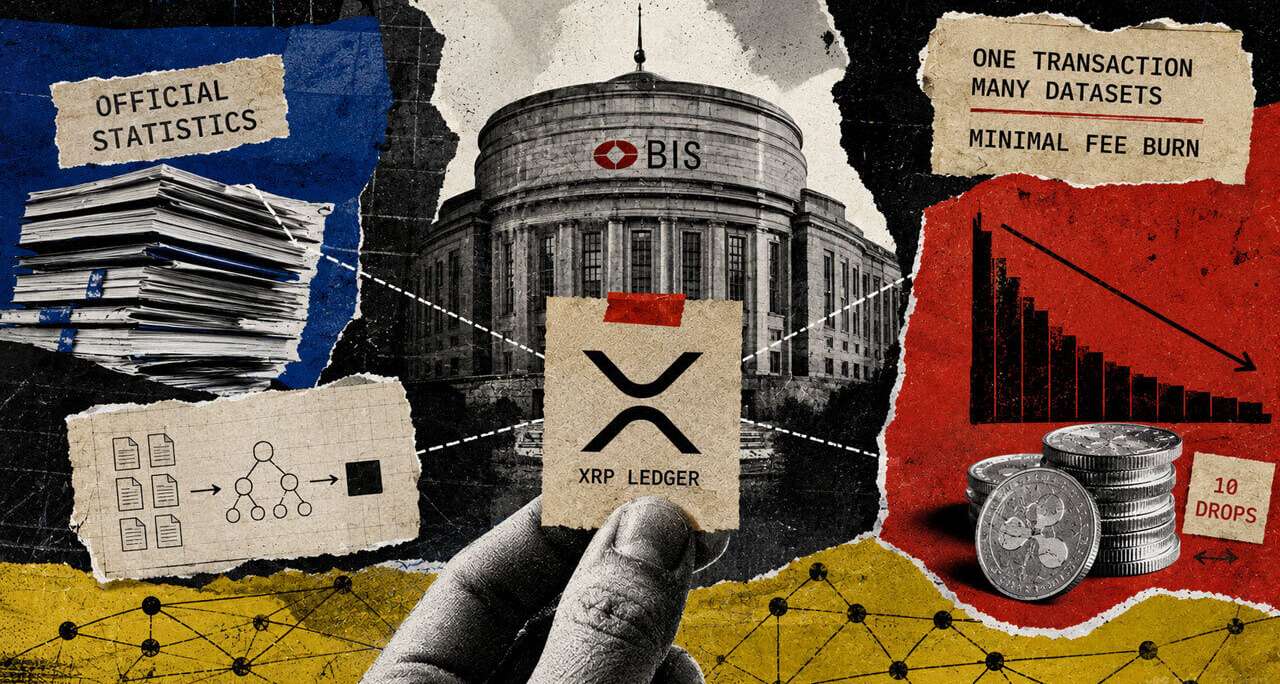
One transaction can authenticate thousands of datasets, leaving fee burn tiny even as institutional-style usage scales.
The Bank for International Settlements released a working paper on Sept. 2 describing a prototype for checking the authenticity of official statistics. The system turns a statistical file into a cryptographic fingerprint, anchors a summary of those fingerprints on XRP Ledger, and lets a recipient compare the file with the public record.
The result creates a split verdict for XRP. The prototype gives XRPL a credible institutional-style use case, while its batching design keeps the direct fee-burn pathway mechanically small. One ledger transaction can represent thousands of datasets, so useful activity can scale much faster than the number of transactions consuming XRP.
The research first appeared online through SAGE on Aug. 1; Sept. 2 marks its release as BIS Working Paper 1374. The paper presents the authors’ views and says its references to firms and projects are illustrative. Its implementation remains an experimental XRPL DevNet proof of concept, and the reviewed sources disclose no commercial relationship with Ripple.
Official statistics commonly travel in SDMX, a standard for exchanging statistical data and metadata. The prototype normalizes an SDMX file and applies SHA3-512 hashing to the whole file or to individual data series. It then combines those fingerprints in a Merkle tree, a structure that compresses a large group of records into one summary value called a root.
The root is written into the memo field of an XRPL transaction. Underlying statistics and the prototype’s operational stores and proofs stay off-chain. The returned SDMX file embeds the transaction reference, ordered fingerprints, and a signed verifiable credential, giving a recipient the material needed to rebuild the root and compare it with the ledger.
XRPL therefore serves as a timestamped public notary for the commitment. It does not serve as the database holding the economic figures. The open-source implementation describes itself as experimental, unsuitable for production, and unmaintained.
The authors selected XRPL for low nominal fees, fast consensus finality, and accessible developer resources. They also made the blockchain interface replaceable, so another ledger could perform the same anchoring role. That design choice makes the prototype evidence for the authentication method and for XRPL’s ability to host it, rather than evidence that the method depends on XRP Ledger.
Performance results came from a single developer workstation connected to XRPL DevNet and using a synthetic SDMX corpus. In those controlled tests, median publication latency was three to five seconds and verification took one to two seconds. The evaluation excluded sustained Mainnet load, an enterprise firewall, hardware-security-module-backed signing, and adversarial conditions. DevNet uses test XRP with no real-world value, so the run produced technical measurements instead of live token demand.
Those boundaries still leave a meaningful result. A statistical publisher could provide an independent integrity check without exposing confidential data on a public ledger. The economic trade-off appears in the same mechanism: Merkle batching reduces the number of on-chain commitments needed to authenticate a large body of information.
The Catalyst
Daily Newsletter
Start with the stories that matter. Get the context behind the headlines and a clear view of what to watch next.
Thanks for signing up to The Catalyst. Look out for your first daily email. If you already receive it, you’re all set.
XRPL’s standard transaction cost normally starts at 10 drops, equal to 0.00001 XRP. When a transaction enters a validated ledger, its fee is destroyed. Network load can raise the cost, and special transaction types can carry different minimums, but the BIS paper uses 10 drops as its base case.
The fee scales with anchoring transactions, while dataset volume can be compressed into batches. The following arithmetic illustrates the gap under a constant 10-drop minimum and standard transactions: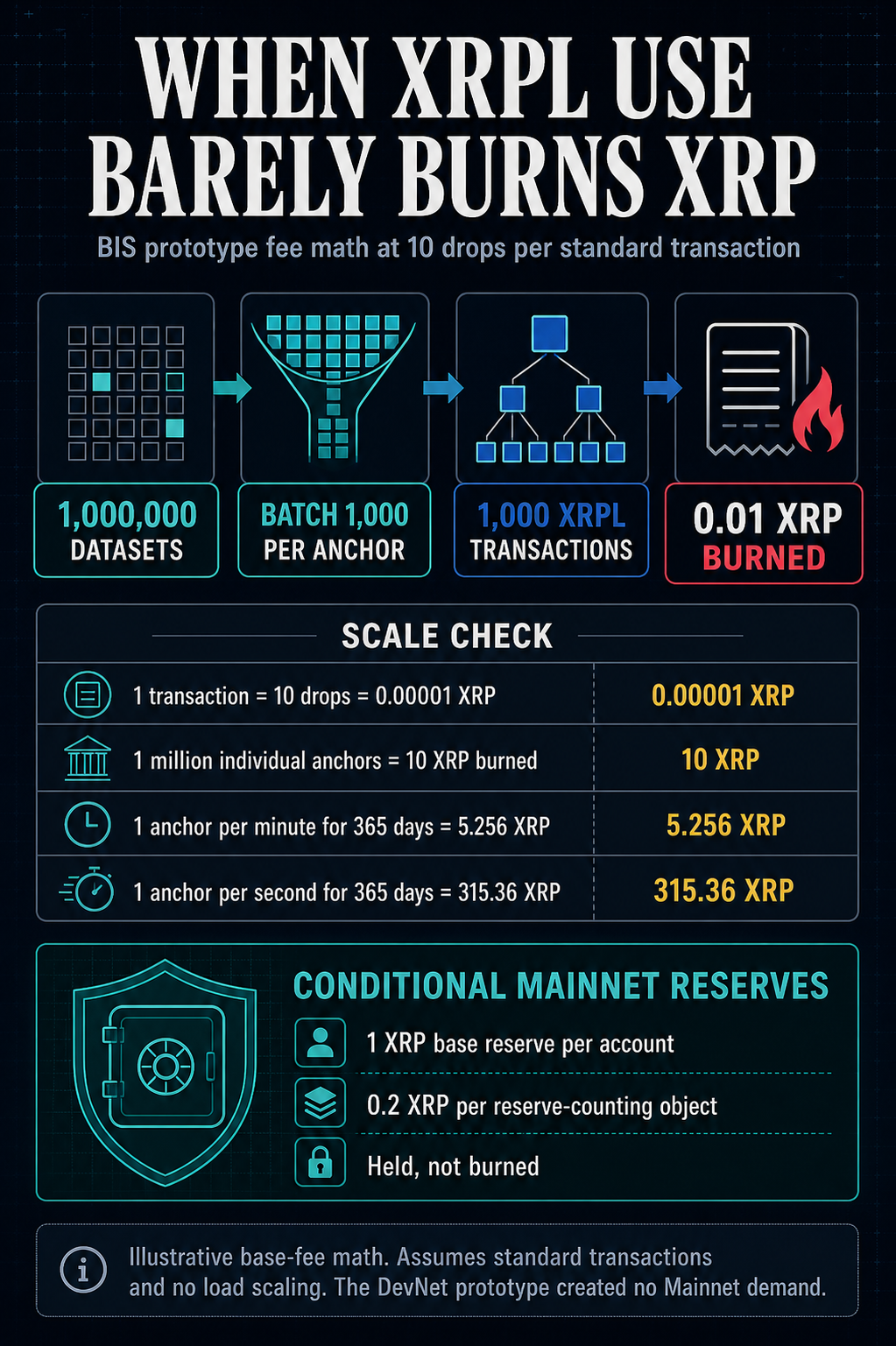
These are scale illustrations, not deployment forecasts. Actual burn would reflect how frequently publishers submit anchors, how many datasets they batch, prevailing network load, and the transaction type. The DevNet prototype generated none of this Mainnet demand.
The paper’s cost model points in the same direction. It assumes a 10-drop fee and an illustrative price of $0.30 per XRP, which is a model input rather than a current quote. With a batch size of 1,000, the authors calculate an on-chain cost of $0.000000003 per dataset. Above roughly 50 items per batch, processing and raw storage dominate the chain and proof-storage costs in their examples.
Urgent releases can favor smaller batches because waiting for more datasets creates delay. Even then, the paper says XRPL’s low nominal fee bounds the penalty. For XRP holders, this means production cadence matters more than the headline number of files or series authenticated.
Mainnet reserves create a second, conditional pathway. Under current XRPL reserve rules, each address must hold a 1 XRP base reserve, with another 0.2 XRP for every reserve-counting ledger object. The network holds those balances as prefunding; ordinary transaction fees are the XRP that gets destroyed.
Reserve demand grows when a deployment needs new accounts or ledger objects. A dataset does not carry its own reserve requirement, and repeated memo anchoring from an existing account does not lock another 1 XRP each time. Validator voting can also change the reserve levels. Production usage could therefore increase held XRP across many new institutional accounts, but the effect depends on deployment architecture rather than dataset throughput.
The paper supports a narrow value-capture conclusion. XRP would supply the fees and reserves for a Mainnet version, while Merkle batching deliberately compresses the recurring fee flow. Under the paper’s assumptions and current fee mechanics, the direct burn channel stays small even as authenticated data volume rises.
XRP’s market price can still respond to expectations, liquidity, and activity elsewhere on the network. Those forces sit outside this prototype. The BIS work establishes XRPL as a viable low-cost authentication layer under controlled conditions; material token demand would require sustained anchoring cadence, broad account creation, or other XRP-centered activity that the experiment did not demonstrate.
XRP is +5.27% over the past 24 hours and currently sits at rank #5 by market cap.
Also known as "Akiba," Liam Wright is a reporter, podcast producer, and Editor-in-Chief at CryptoSlate. He believes that decentralized technology has the potential to make…
CryptoSlate may use AI tools to support research, editing, and production workflows. Our journalism remains human-led, with our editorial team responsible for every published article. Read our full AI usage disclaimer.
Our writers’ opinions are solely their own and do not reflect the opinion of CryptoSlate. None of the information you read on CryptoSlate should be taken as investment advice, nor does CryptoSlate endorse any project that may be mentioned or linked to in this article.
Buying and trading cryptocurrencies should be considered a high-risk activity. Please do your own due diligence before taking any action related to content within this article. Finally, CryptoSlate takes no responsibility should you lose money trading cryptocurrencies. For more information, see our company disclaimers.
We use cookies to improve your experience on our site. By using our site, you consent to cookies.
Manage your cookie preferences below:
Essential cookies enable basic functions and are necessary for the proper function of the website.
CloudFlare provides web performance and security solutions, enhancing site speed and protecting against threats.
Service URL: developers.cloudflare.com (opens in a new window)
Google Analytics is a powerful tool that tracks and analyzes website traffic for informed marketing decisions.
Service URL: policies.google.com (opens in a new window)
Statistics cookies collect information anonymously. This information helps us understand how visitors use our website.
Clarity is a web analytics service that tracks and reports website traffic.
Service URL: clarity.microsoft.com (opens in a new window)
You can find more information in our Privacy Policy and .
Loading image…
This image could not be loaded.
The Catalyst
Daily Newsletter
Start with the stories that matter. Get the context behind the headlines and a clear view of what to watch next.
Thanks for signing up to The Catalyst. Look out for your first daily email. If you already receive it, you’re all set.
Free newsletters. Unsubscribe anytime.
TermsPrivacy
The Catalyst
Daily Newsletter
Start with the stories that matter. Get the context behind the headlines and a clear view of what to watch next.
Thanks for signing up to The Catalyst. Look out for your first daily email. If you already receive it, you’re all set.
Intelligence for the crypto economy
Follow us
Subscribe
By using this website, you agree to our Terms and Conditions and Privacy Policy. CryptoSlate has no affiliation or relationship with any company or project unless explicitly stated otherwise. CryptoSlate is an informational website that provides news about coins, companies and products. None of the information you read on CryptoSlate should be taken as investment advice.
Buying and trading cryptocurrencies should be considered a high-risk activity. Please do your own diligence before making any investment decisions. CryptoSlate is not accountable, directly or indirectly, for any damage or loss incurred, alleged or otherwise, in connection to the use of or reliance on any content you read on the site. Read all disclaimers