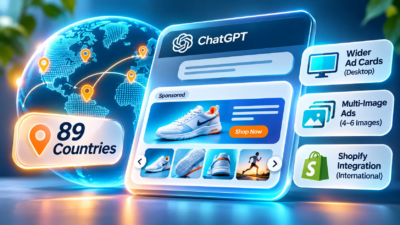
Advertising inside AI chatbots has moved from experiment to business line, and the early returns suggest the format can hold its own against conventional search. OpenAI now counts more than 100,000 customers running ads in ChatGPT since the format launched in February, while Google has pushed ads in its AI Mode search chatbot into 10 additional countries beyond the United States and says users regard them as highly relevant.Not everyone is playing. Anthropic has kept Claude free of advertising, a commitment it made in its Super Bowl commercial this year and one its recent IPO filing did not revisit; roughly $112 billion in investor capital makes that stance easier to sustain. But for the broader industry, ad revenue is increasingly viewed as a way to offset the steep cost of generating AI responses, and it matters most for smaller chatbot platforms that lack either top-tier venture backing or the balance sheets of the largest technology companies.The first measurable signals come from Koah Labs, a San Francisco ad-technology startup that places sponsored content across more than 200 AI apps, including DeepAI and Liner, for brands such as telehealth company Hims and flower delivery service UrbanStems. Koah has drawn about a tenth of OpenAI’s advertiser base, but Chief Executive Nic Baird said the network’s experience offers an early read on which tactics work.Note: Figures are Koah Labs estimates as described by CEO Nic Baird.Ads written partly by AI rather than entirely by humans draw twice the clicks, according to Baird. The reason is not fully understood, but copy produced by a model may sit more naturally beside a model’s own output. Koah grounds its ads in product details and images supplied by advertisers, which appears to have kept AI-fabricated errors out of the placements users see. Regulated advertisers, drugmakers among them, still default to tighter human control over messaging and, in Koah’s experience, generate weaker results.Targeting is where chatbot inventory diverges most sharply from search. A Google query about help with stress is likely to surface therapists; within Koah’s network, spa promotions have performed well when served after prompts mentioning stress. Baird attributes the difference to context: Koah can choose and tailor an ad based not only on the prompt but on the AI platform’s response and the rest of the conversation, and chatbot prompts run at least twice as long as typical search queries. He argues that users already move across several topics in a single chatbot session, which may leave them more open to adjacent marketing than they are in traditional search.When Koah is called on to serve an ad, it generally receives the user’s full conversation up to that point. Baird said the company anonymizes queries and stores them in de-identified form, but he declined to elaborate on data collection and storage practices. He acknowledged that personalization can become intrusive while contending that it can benefit users and advertisers as the technology matures, for instance by informing the page that loads after a click.Koah has no data on whether users actually want those customized pages. The industry has long maintained that people respond better to ads that feel relevant.Customer support is another opening. By Koah’s estimate, one in four chatbot queries about a retailer or brand involves a return, exchange or similar issue, and Baird expects manufacturers and retailers to eventually target dissatisfied customers with warranty reminders and AI-mediated service that could steer them away from costlier human support. The best outcome is a faster resolution; the worst is a wasted ad buy and a more frustrated customer.None of the apps in Koah’s network yet offer AI agents that shop autonomously, though products such as Instinct and Meta’s Muse are beginning to take over purchasing tasks. Meta Chief Executive Mark Zuckerberg recently said Muse could become the company’s largest revenue source but indicated the money would come from transaction fees rather than advertising. Early research suggests ads can still sway AI agents, and Baird expects an opening to give an agent the best available recommendation, combining a strong discount, a relevant product and a simple path to purchase. The chatbot would have to make sponsorship unmistakably clear to the agent or risk user trust, he said.The market could also stall before agents take hold. Kevin Baragona, chief executive of DeepAI, said ad revenue has been meaningful but that he is not committed to it because the experience does not yet feel right on privacy and design grounds. “I don’t think the ads are working terribly well for anyone,” he said.The stakes extend beyond the chatbot companies themselves. For advertisers, the channel offers conversational context that search cannot replicate, but it also raises unresolved questions about how much of a private exchange should inform a commercial message. For investors, the divergence between OpenAI’s aggressive buildout and Anthropic’s ad-free positioning sets up a test of whether subscription and enterprise revenue alone can sustain frontier-model economics, or whether advertising becomes the industry’s default second revenue stream.The news and data on this website are for reference only and do not constitute investment advice or an offer to buy or sell. Information is sourced from exchanges and public sources, and may be delayed, interrupted, or updated. While we strive for accuracy, we do not guarantee timeliness, correctness, or completeness. Content may include external links for which we are not responsible. By using this site, you agree that we and our partners are not liable for any losses. Investment carries full responsibility; please carefully assess risks and consult professionals. If there are errors in the content, please contact us for correction.source
Chatbot Ads Take Off: OpenAI Tops 100,000 Advertisers as AI Search Rivals Google's Click Rates – BigGo Finance
Related Posts
 nov 6, 2026
 nov 6, 2026