
CALL US AT:
Get in Touch With Us
Home » News »
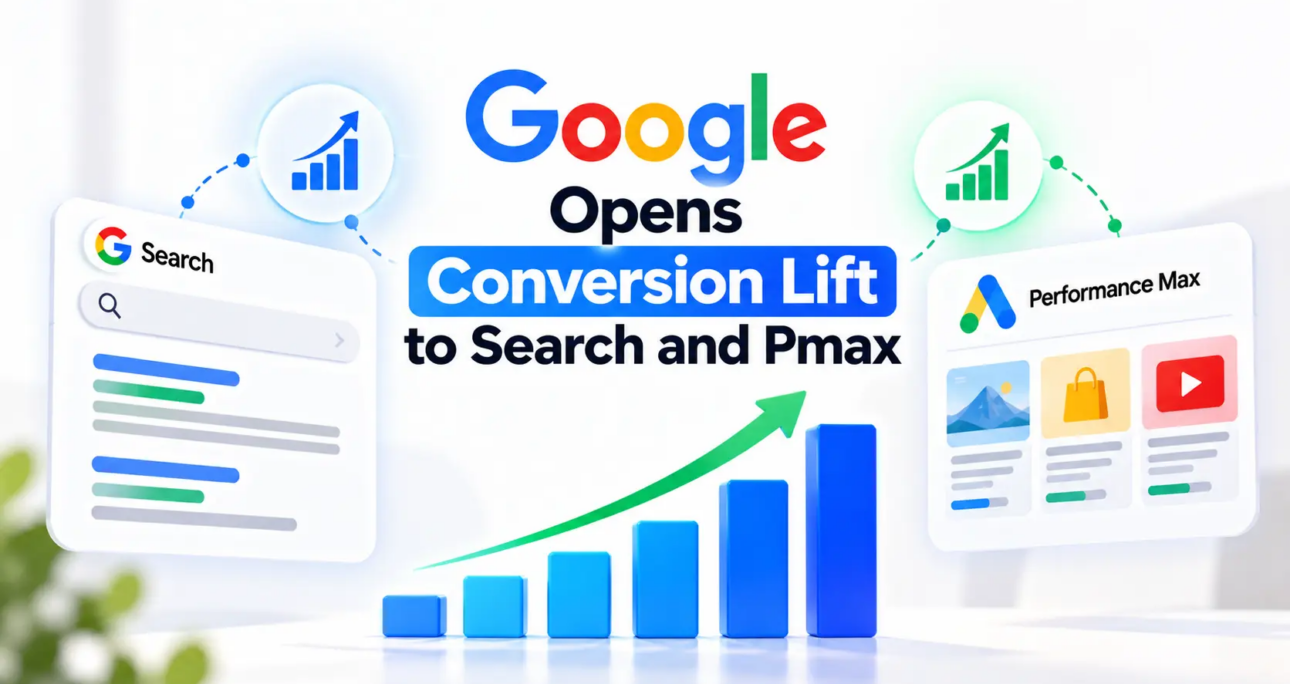
Google Ads is set to expand its Conversion Lift feature to include Search and Performance Max campaigns. Eligible advertisers can now perform their own incrementality tests without a Google representative being present. Search Engine Land published the news on October 7, 2026.
The question is simple. Did your ads lead to an increase in sales, or did they simply reap the rewards of those that might have occurred despite the ads. Conversion Lift is designed to answer this.
User-based Conversion Lift has previously been available in Display & Video 360 for audiences applied to Display, Video, Demand Gen and App campaigns. Search and Performance Max campaign types have today joined them. Previously, advertisers were required to contact a Google representative before being able to use this feature.
Such a tedious procedure has now become a thing of the past for Search and Performance Max advertisers. This is important, as these campaign types have the largest share of advertiser budgets.
Self-serve access to the uplift testing feature is subject to certain restrictions. According to Google’s help center, there are three key eligibility criteria:
It may be concluded that small accounts are highly unlikely to meet these requirements. For instance, a company that generates dozens of conversions per month will not be able to conduct a reliable experiment.
Conversion Lift creates a holdout group of users who are not exposed to the campaigns being evaluated and compares them to the users who are exposed against the same set of campaigns. This allows Google to attribute lifts or declines in performance to changes in behavior rather than to attribution models.
Attribution models distribute credit between different touchpoints. A lift test tries to answer a different question: did our ads prompt users to do something?
Advertises determine the holdout size themselves, with an option between 1-50%. A bigger sample size means more accuracy, but there is an opportunity cost: this traffic isn’t being exposed to one’s ads. A smaller holdout requires a longer study period for accuracy.
Attribution will tell you which touchpoints to get credit for, but it won’t say whether they actually drove the results. A lift test will help you distinguish between conversions that were genuinely driven by your campaigns and conversions that would have occurred regardless of them.
The situation is further complicated by the fact that Performance Max can run across multiple Google channels, and the traditional approach of attribution modeling can significantly underestimate its impact. This is where a holdout test is useful, which compares the performance of the entire campaign against the control group that was never exposed to it.
For advertisers that have significantly invested into either channel, this can be an important consideration. If one campaign has a high ROAS but a low lift, it might be worth reallocating some of the budget to the one with a lower ROAS but a higher lift.
The process takes place within Google Ads. From the Campaigns tab, you have to select Experiments and then the Lift studies tab. The new study needs to be created; choosing Conversion Lift based on users should be done after that.
A user has to set the study name, select the campaigns, and set goals. The metric focus, dates, and holdback size should also be determined. Using conversions focus helps retrieve incremental conversions and incremental cost per action, whereas, with conversion value focus, it is possible to get incremental return on ad spend.
Google also shows a study power estimate. It runs from 50% to 95% and tells you how certain the results are likely to be. Google advises aiming for 90% or higher. Results between 50% and 90% can still be used as directional.
Google’s guidance is practical. A few points stand out.
Conversion Lift is still not suitable for everyone. Google research’s help page states that the tool is unavailable for all accounts and requires contacting a Google representative for alpha and beta campaign types.
There is also a disadvantage of additional costs since every holdout represents the ads that were not displayed. According to Google, the majority of advertisers run one to two experiments yearly. It means that the most appropriate time to use Conversion Lift is during the advertising budget allocation period or before significant investments in advertising.
Finally, a confidence interval must also be considered when interpreting results since one experiment is just a sample that represents an overall trend.
First of all, make sure you have at least 1000 conversions observed and a five thousand-dollar study budget. Besides, it is critical to audit your conversion tracking system; otherwise, you will not get reliable results from the test because of the low-quality data.
Then, define your question about the test. For instance, do you want to know what Search brings to your overall performance beyond your other marketing channels, or what PMax is worth compared to your other campaigns? The more precise the question is, the better results you will get. Lastly, remember that it is always a good idea to plan the study before allocating the huge budget.
Q 1: What is Conversion Lift?
It is a Google Ads measurement tool that estimates the number of conversions that were impacted by your ads.
Q 2: What is new about this update?
The feature now supports Search and Performance Max campaigns, and is available to self-serve advertisers (previously advertisers needed a Google representative to open a study).
Q 3: What are the minimum requirements?
A minimum of 1,000 observed conversions (not supplemented), Minimum daily budget of $5,000, Account-level conversion action (installed conversion tracking)
Q 4: How is this different from attribution?
Conversion Lift reveals if and the extent to which the advertising had any effect, whereas attribution models distribute credit across various touchpoints. Basically, using conversion lift allows you to separate the conversions generated by your Google campaign from the ones that would’ve happened regardless of advertising.
Q 5: How big should the holdout be?
The percentage ranges between 1-50%, where a bigger holdout affects more impressions and thus increases the size of the sample. However, keep in mind that the bigger the holdout group the more value you lose by not serving ads. The tool suggests the size of the holdout when setting up a study.
Q 6: How long should a study run?
It can last for as long as 7 days, but it is not recommended to set it lower than 14 days. Google states businesses with longer sales cycles (conversion lag) benefit from a longer study.
Q 7: What does study power mean?
It represents the probability of your observed power given the sample size (ranges from 50% to 95%). The higher the percentage, the more confidence you can have in the accuracy of the study results. Google recommends the study power be at least 90%. Note that lower percentages can still provide some directional insight.
Q 8: Can I change campaigns during a study?
Adjustments to budgets and recommendations are permitted. However Google warns that changes to creatives, audiences, and other advertising features could impact study performance and conclusions.
Q 9: Is Conversion Lift available to every advertiser?
The feature is selectively available to some advertisers. Google notes that certain alpha and beta campaign types may still require an advertiser representative.
Newsletter Signup
X has introduced a new ad product called X Lift that uses artificial intelligence to
Reddit has announced a set of upgrades to its Lead Gen Ads. The updates are
Google Ads is set to expand its Conversion Lift feature to include Search and Performance
Meta announced changes to its advertising business during its Advertising Week event in New York
Google has started giving certain site owners an indication of the percentage of users who
Google is slowly launching its Merchant Center Universal Commerce Protocol (UCP) integration hub to U.S.
Take the next step towards transforming your digital marketing and achieving unparalleled growth. Whether you’re looking to refine your strategy, boost conversions, or build a dominant online brand, ALM Corp has the expertise to make it happen.
Drop us an email
info@almcorp.com
Toronto
80 Atlantic Ave, 4th Floor
Toronto, ON, M6K 1X9
New York
413 W 14th St Ground Floor and Suite #200, New York, NY 10014
London
Mappin House, 4 Winsley St,
London W1W 8HF, United Kingdom
Join Our YouTube Community
Services
White Label Services
Resources
About Us
Join Our YouTube Community
© Copyright 2026 | ALM Corp | All Rights Reserved.
Google Opens Conversion Lift to Search and Pmax – ALM Corp
Related Posts
 out 10, 2026
 out 10, 2026
 out 10, 2026