
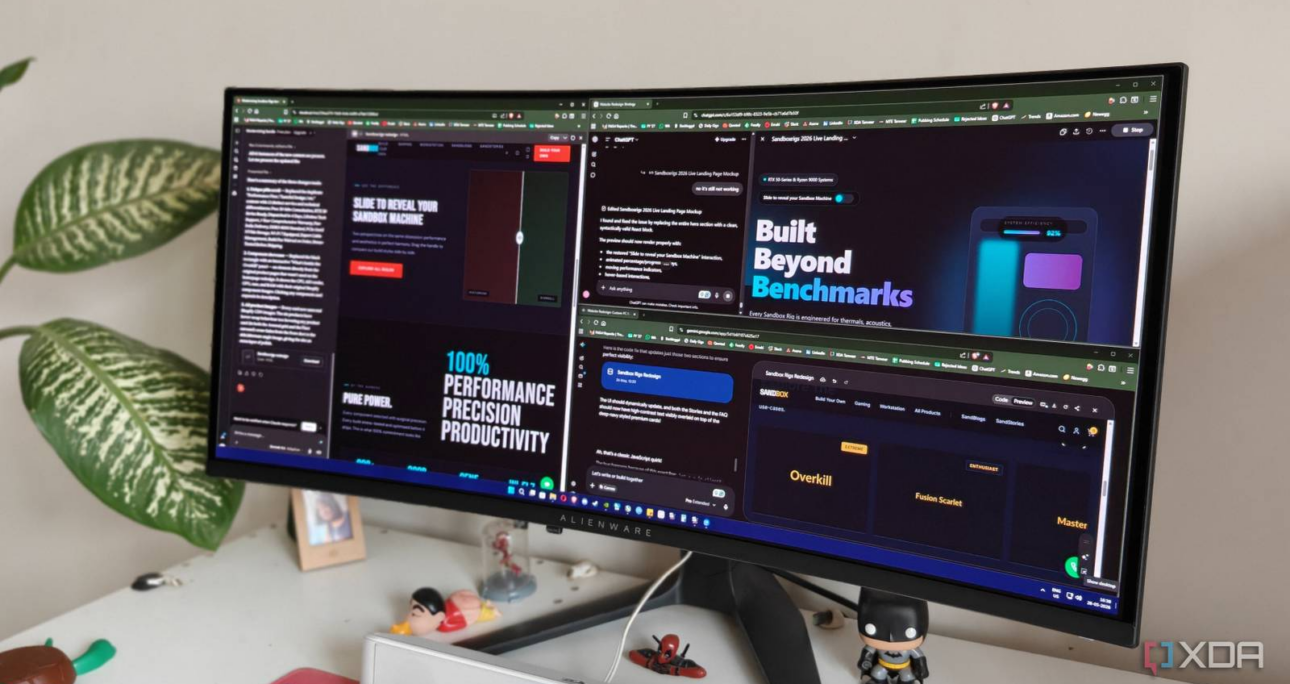
I’ve written about not using LLMs too much in my daily workflow. They just seem to fall short of the kind of output I expect when ideating and researching article topics. That said, when I needed some inspiration to redesign my website’s landing page, I was curious about how tools like Claude, ChatGPT, and Gemini would perform at the same job. My PC building business has been on the back burner for a while, but I’m finally ready to resume it, and I need a website overhaul. I had read a lot about the design capabilities of Claude, Gemini, and ChatGPT, so asking each of them for a landing page prototype seemed like the right way to go. When we created the website back in 2023, we had ignored each of these tools, focusing on conventional web design. This time, though, I wanted to see for myself how far cloud LLMs had come in three years. While each of the three tools fell short in different ways, one of them was clearly ahead where it mattered the most.Time to put some cloud LLMs through a Ninja Warrior workoutTo be fair, my existing website wasn’t completely outdated. The six pre-built PCs we advertise were naturally out-of-date, since newer components had come out since we had paused the business. However, the design language, brand colors, navigation, and product images were still great. The typography and a handful of design elements felt a bit too simple, and that’s why I felt a redesign could help keep things fresh. My expectation going in wasn’t to accept whatever output these LLMs spat out. Still, I wanted some inspiration for the changes I wanted to make, and I was even open to a major overhaul if the three tools delivered something truly exceptional.I’m using the free tiers of Claude, Gemini, and ChatGPT to showcase the results most people would get from these LLMs. I supplied my landing page document to Sonnet 4.6 (Adaptive), GPT -4o (with Canvas), and Gemini 2.5 Pro (with Canvas). I gave identical prompts to each of them, and intentionally left room for interpretation to see which model understood the assignment better:“Redesign my website’s landing page. It is for a custom PC building business, and has been on pause for the last year. Hence, the PCs and components are outdated. I need you to revise the hardware for each of the builds to reflect the latest components. I also need you to redesign the look and feel of the website, including the hero section, broader layout, typography, brand colors, accent colors, and CTAs. Remember that the site should still retain the interactive elements, and shouldn’t remove any of the existing elements. You can add additional elements as you see fit. The overall design should reflect a premium retail business.”In a nutshell, Claude pulled significantly ahead of ChatGPT and Gemini. It gave me a polished design and needed the least back-and-forth. Of course, none of the models were perfect, and the differences are what will matter to anyone hoping to use these LLMs for similar purposes.ChatGPT is one of the best LLMs out there, and it's completely free to use. You'll need to make an account, but there's not much else to it. And the award for the best UX design goes to…The thing that immediately stood out to me was the quality of the initial output. ChatGPT returned a serviceable landing page with a reasonably clean layout that had blue accents on a dark background. The problem was that it had automatically changed the names of the builds and the header menus. And after repeated prompts, it failed to include the interactive elements present on the original landing page that I had provided. Another issue was the missing images from the entire webpage, but that’s something that even Gemini and Claude struggled with.Gemini retained the original menu and product names, but its redesigned webpage looked terribly generic. It had an outdated design and used stock images, which further hurt the expected premium esthetic. I asked it multiple times to improve the design, and it ultimately arrived at a gold-and-white layout after showing a monochrome one on the way. The gold-and-white landing page looked okay, but it had tons of legibility issues, such as text and backgrounds rendered in the same color, making many portions of the text invisible. Unlike ChatGPT, however, Gemini retained nearly all the interactive elements present on the original webpage.The final output from the two LLMs led me to conclude that Gemini was better than ChatGPT, but it needed extra legwork to get to the desired destination. Even ChatGPT made me work more than I had expected on a simple webpage redesign project. Needless to say, I had high hopes for Claude.Gemini’s free tier has features ChatGPT Plus charges $20 a month forIt’s no surprise that Claude is still superior where it counts the most. The very first output I got was pretty close to what I would call a premium design. It retained the dark theme of the original webpage, ensured clean accents that popped, and didn’t mess up any of the menu or product names. I had a nearly finished prototype within minutes, with no real need to ask for edits. Minor issues like redundant text in one of the sections and a blank rectangular element were still present, but they were easy enough to remove with a single prompt — I did have to wait five hours to do that, though. I ran out of free messages way before I thought I would.It seems designers have to choose between using Claude for quick and efficient prototyping, and using Gemini or ChatGPT for a longer but more flexible project. Claude’s free tier seems little more than an ad for its paid versions, while Gemini and ChatGPT allow virtually limitless access, unless you’re working on too many deep research, photo generation, or video generation projects in a day. I can see myself obtaining better results from Gemini if I spend more time on it, something which isn’t possible on Claude’s free tier. As someone who works on design as part of their job, you should absolutely consider paying for Claude Pro or Max. Others who need these tools for one-off projects should spend a considerable amount of time testing the limits of the free tiers before thinking of taking out their credit cards.Claude is an AI assistant and LLM developed by Anthropic.So close, yet so far. In my experience, Claude came out ahead, but on the free tier, it’s barely possible to complete a project. The initial output was much better than what I got from ChatGPT and Gemini, but the other two didn’t lock me out after a handful of messages. The choice comes down to the level of project complexity you’re dealing with. For quick prototyping and brainstorming, Claude’s free tier can be sufficient, but for anything more time-consuming, you might want to switch to Gemini, unless you want to pay for Claude. Thank you for subscribing to our newsletter, We want to hear from you. Share your perspective in the comments below, and please keep the conversation respectful.Your comment has not been savedYou used GPT 4o? How? That’s been gone a long time. Why didn’t you use codex? Why didn’t you use 5.5?I don’t get this. It makes no sense.No, you didn’t write this article yourself. It was created by AI. If you had written it yourself, you would know that on May 26, 2026, you would be using Sonnet 4.7, GPT 5.5, and Gemini 3.1. (Possibly even 3.5.)Either this story is completely made up or it’s extremely old and irrelevant. Totally agree, but wanna add. Paying for Claude is not a bad choice, cause limits are more than good and quality of it’s work is on different level comparing to gpt and Gemini. Gpt may answer faster and shorter on questions, which may be preferable sometimes, but for everything related to coding (even learning it) Claude is tier one. The best of XDA, directly in your inbox.By subscribing, you agree to receive newsletter and marketing emails, and accept our Terms of Use and Privacy Policy. You can unsubscribe anytime.source
I asked Claude, Gemini, and ChatGPT to redesign my webpage — only one didn't make it uglier – XDA
Related Posts
 nov 5, 2026
 nov 5, 2026