
Copyright: Any unauthorized use or reproduction of The Daily Star content for commercial purposes
is strictly prohibited and constitutes copyright infringement liable to legal action.
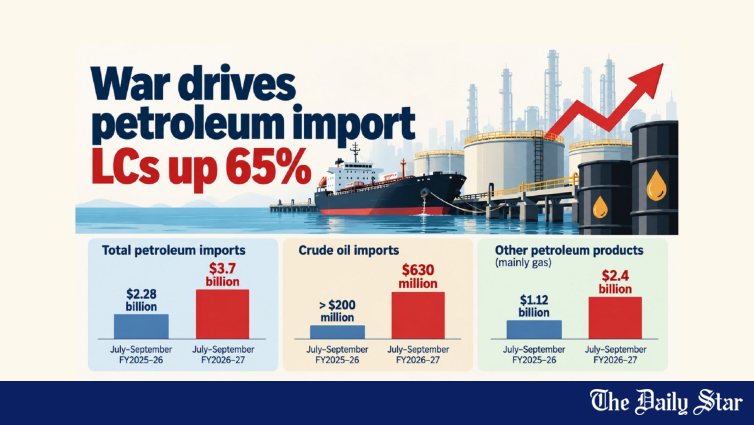
Letters of credit (LCs) opened for petroleum and petroleum product imports surged 65 percent year-on-year in the first quarter of the current fiscal year as the Middle East war has driven up global oil and gas prices, raising concerns over mounting pressure on government subsidies and the wider economy.
Bangladesh opened LCs worth $3.7 billion in the July-September period of fiscal year 2026-27, up from $2.28 billion a year earlier, according to Bangladesh Bank (BB) data.
LCs for crude oil imports tripled to around $630 million in the first quarter of FY27 from more than $200 million a year earlier. For other petroleum products, mainly gas, the value of LCs opened by state-owned and private firms rose to $2.4 billion from $1.12 billion over the same period.
Shafiqul Alam, lead analyst for Bangladesh Energy (South Asia) at the Institute for Energy Economics and Financial Analysis (IEEFA), said import volumes are not increasing, but the cost of buying fuel is rising.
“In fact, the money we are spending is increasing,” he said, adding that fuel import costs could rise to around $18-$20 billion this year from $12-$13 billion earlier. “If the crisis becomes prolonged, the expenditure could rise further.”
Rising energy costs and concerns over supply shortages have already weighed on private investment and raised concerns about higher inflation.
Earlier this month, the World Bank said in its Bangladesh Development Update that economic growth would stagnate at 3.4 percent in FY27, citing persistent energy shortages and higher costs that continue to disrupt private investment and raise operating expenses for businesses.
“Prices of petroleum products have roughly doubled from a year ago. We are paying extra shipping costs and premiums to suppliers to bring in oil,” said a senior official of the state-owned Bangladesh Petroleum Corporation (BPC), the sole oil importer.
Bangladesh, which heavily depends on energy imports, requires more than 68 lakh tonnes of petroleum a year, with diesel accounting for more than two-thirds of total demand.
The BPC official said prices have risen because of the war and the closure of the Strait of Hormuz, which used to handle one-fifth of global oil shipments before the conflict, although import volumes remain almost unchanged.
In the July-September quarter, LC settlements for petroleum and petroleum product imports rose 26 percent year-on-year to $2.93 billion.
Globally, average Brent crude prices rose by more than 40 percent year-on-year to $97 a barrel in the July-September period this year, from $69 a year earlier, according to the World Bank’s latest commodity price data.
Similarly, the average price of liquefied natural gas (LNG) in Japan also rose, reaching $14.45 per million British thermal units (MMBtu) in the quarter, up from $11.73 a year earlier.
Bangladesh meets more than one-third of its gas demand through imports. It has had to rely on the spot market for LNG after its long-term supplier, QatarEnergy, declared force majeure, a term for an extraordinary event beyond a party’s control that prevents it from meeting a contractual obligation.
By the end of last month, QatarEnergy had extended force majeure notices to Bangladesh until November, according to media reports.
The country has since turned to the spot market to buy LNG at $30 per MMBtu, almost three times the price it typically paid before the war in the Middle East. The government is scrambling to secure supplies amid a prolonged gas crisis.
Energy analyst Shafiqul said the higher cost of imported LNG would also increase government subsidies.
“Subsidies for LNG will rise significantly because, if we import the same quantity of LNG this year as we did in 2025, our expenditure on LNG alone will be more than double that of the previous year,” he said.
Amid rising oil import costs, the government raised prices of all four major petroleum products by Tk 20 a litre last month, passing on a large share of the higher costs to consumers.
It was the biggest increase since the record adjustment in August 2022, triggered by an energy crisis following the Russia-Ukraine war.
According to Shafiqul, persistently high prices could make it harder for the government to maintain adequate fuel supplies.
“If prices remain elevated or continue at these levels, it will be difficult for the government to ensure an adequate supply of fuel.”
He added that fiscal pressure could limit the amount of fuel available to industries. “If the government cannot supply sufficient fuel to industries, it will affect GDP growth and employment.”
He also noted that higher fuel import bills would put pressure on external payments and foreign currency reserves.
“The reason is that our sources of foreign currency are very limited. We have garment exports and remittances. Beyond these, there aren’t many other sources,” he said.
“So, if our expenditure on fuel imports increases, if it doubles or rises by 70-80 percent, that will obviously have an impact on our foreign currency position. The government may also have to take on additional debt,” he said.
Meanwhile, the BPC official said petroleum supplies remain adequate, and there was no risk of a shortage.
“We have ensured the supply of oil until December,” he added.
Similar to Shafiqul, Selim Raihan, executive director of the South Asian Network on Economic Modeling (SANEM), said higher import costs may increase fuel subsidies, strain foreign exchange reserves and weaken the taka, while pushing up inflation through higher transport, power and production costs.
“This could force the government to divert funds from development and social spending,” said the economist.
He called for accelerating investment in renewable energy to reduce dependence on imported fuels, ease pressure on foreign exchange reserves and strengthen long-term energy security.
Apart from concerns over foreign currency position and inflation, the fuel shock risks eroding external competitiveness for Bangladesh.
“The critical challenge is that the fuel shock hits an economy already struggling with weak investment, costly finance and energy constraints. Our external competitiveness is also being eroded quite seriously,” said Abdur Razzauqe, chairman of Research and Policy Integration for Development (RAPID).
“Overall, the room to absorb another external shock is extremely limited,” he added.
Copyright: Any unauthorized use or reproduction of The Daily Star content for commercial purposes
is strictly prohibited and constitutes copyright infringement liable to legal action.
LC openings for petroleum imports surge 65% amid war – The Daily Star
Related Posts
 out 20, 2026
 out 20, 2026