
Science and Technology
In the United States, a group made up of parents, youth, and hundreds of school districts is taking the world’s largest social media companies to a historic trial in an open court for the first time, accusing Meta, YouTube, TikTok, and Snap of intentionally designing addictive products. In total, around 1,600 people are participating in the lawsuits, involving over 350 families and 250 school districts, in a case that could redefine the responsibility of big tech over youth mental health.
The first trial in Los Angeles revolves around the story of a 19-year-old identified by the initials KGM, who claims to have developed mental health issues as a child after becoming addicted to social media applications. If this historic trial paves the way for favorable verdicts for the plaintiffs, thousands of similar lawsuits could gain strength and push for deep changes in digital platforms.
The case marks a turning point because, for the first time, social media companies will be judged by a jury for the addictive impact of their products on youth.
Mercado Livre has started selling medications in Brazil with delivery in up to 3 hours, and the project that launches in São Paulo may expand to the entire country, transforming the way millions of Brazilians buy medicines.
While the South begins April with sun and heat, a change in the weather already has a defined scenario in Brazil, and forecasts indicate heavy rain in the North and a sharp drop in temperature in the coming days.
Elon Musk wants to place humanoid robots in roles currently occupied by people, leading alongside giants like Amazon, Nvidia, and Figure in a race to replace human labor with machines, and advocates for a future where working would cease to be an obligation and become a choice.
A US company creates a facade that looks like stone or wood but generates energy: “invisible” solar panels for walls, easy installation, up to 130 W, and an off-grid YouTuber showcases it and raises funds for a battery.
The plaintiffs accuse Meta, Snap, TikTok, and YouTube of:
The lawsuit seeks two types of outcomes:
If the jury finds that millions of children were harmed by the use of the platforms, this historic trial could become a watershed moment in how social media is designed and regulated, opening new fronts for lawsuits against the tech giants.
The lawsuits are coordinated in a large collective proceeding known as JCCP (Judicial Council Coordinated Proceeding) in the Los Angeles Superior Court.
Participants include:
The KGM case is the first of about 22 trials known as “pioneers.” They serve as tests to gauge:
Matthew Bergman, founder of the Social Media Victims Law Center, which represents the plaintiffs, described the moment as unprecedented, recalling that a social media company had never been tried by a jury under these conditions.
For him, the platforms have operated for years in a protection zone, sheltered by legal loopholes, without taking responsibility for their effects on children and teenagers.
The lawyers’ line of attack mirrors a strategy that became famous in the 1990s when the tobacco industry was put on the spot. At that time, the focus was to show that:
Now, in the historic trial against social media platforms, the logic is similar. The legal team argues that:
The lawyers say a large amount of internal documents will be released during the trial, including material that was previously confidential.
The expectation is that these files will reveal internal discussions about addiction, damage to youth mental health, and design decisions that prioritized screen time over safety.
A central part of the case relies on internal documents that describe the social networks as “addictive”.
Attorney Julia Duncan from the American Association for Justice states that some records show employees:
These phrases add to discussions about features such as:
For the plaintiffs, it is not just about content, but about design choices, something that the judge has already highlighted by deciding that the jury should also analyze the architecture of the platforms, not just what users post.
Bergman went straight to the point in stating that there is “a lost generation of children” and that this was not an accident but “a design choice.”
On the eve of the historic trial, two companies moved to avoid the first direct confrontation in the KGM case.
Snap reached a settlement with the young woman’s lawyers, denying wrongdoing but resolving the case amicably.
The financial terms were not disclosed, and the company remains a defendant in other lawsuits within the same set.
TikTok also reached a settlement with the plaintiff on the eve of the trial’s start, meaning it does not appear alongside Meta and YouTube in the specific KGM case.
According to Sacha Haworth, director of the Tech Oversight Project, “you don’t settle unless you don’t want these things to become public”.
For her, the public still has no idea of the extent of what might come to light when testimonies from parents, youth, and internal documents are presented in court.
The companies publicly adopt a firm defensive stance.
In general, social networks often argue that:
The plaintiffs’ bet, however, is to shift the focus from content to design, attempting to convince the jury that the problem is not just what is posted, but how the entire system was built to aggressively capture attention.
The trials occur in parallel with growing political pressure in Washington. A bipartisan group of U.S. lawmakers has been calling big tech executives to Congress to explain:
Internal whistleblowers have been reinforcing this narrative by stating that the companies knew about the potential damages to children and teenagers and did little or nothing to change the engagement logic.
In a hearing in January 2024, Senator Josh Hawley pressured Mark Zuckerberg to apologize publicly.
Despite the apology request, families involved in the lawsuits claim that Meta’s stance has changed little in practice and that damage continues to accumulate.
Cases like that of Juliana Arnold, founder of Parents Rise, illustrate the drama. She lost her teenage daughter in 2022 due to a lethal overdose after messaging a dealer on Instagram.
For her, this historic trial is also a moment of collective catharsis: “We have waited for this for years, so that the truth could come to light.”
In addition to the case in Los Angeles, a series of federal trials is scheduled for June in San Francisco, in the form of multidistrict litigation (MDL), with over 235 plaintiffs, including families, school districts, and attorneys general from nearly 30 states.
The sum of these cases indicates that social media is entering a new phase of legal scrutiny, where the design of the platforms may be treated as products with inherent risk, rather than just as neutral intermediaries of content. Depending on the verdicts, the outcome could be:
For many parents and youth, however, the central point is different. They want someone to be held accountable for what happened in recent years, in which the lives of an entire generation have been shaped by endless feeds, constant notifications, and algorithms that know exactly what to keep on the screen.
In your opinion, can this historic trial against social media in the United States truly change the way we use platforms like Instagram, TikTok, and YouTube, or will the companies manage to come out almost unscathed once again?
Produzo conteúdos diários sobre economia, curiosidades, setor automotivo, tecnologia, inovação, construção e setor de petróleo e gás, com foco no que realmente importa para o mercado brasileiro. Aqui, você encontra oportunidades de trabalho atualizadas e as principais movimentações da indústria. Tem uma sugestão de pauta ou quer divulgar sua vaga? Fale comigo: carlatdl016@gmail.com
© 2026 Click Petróleo e Gás – All rights reserved
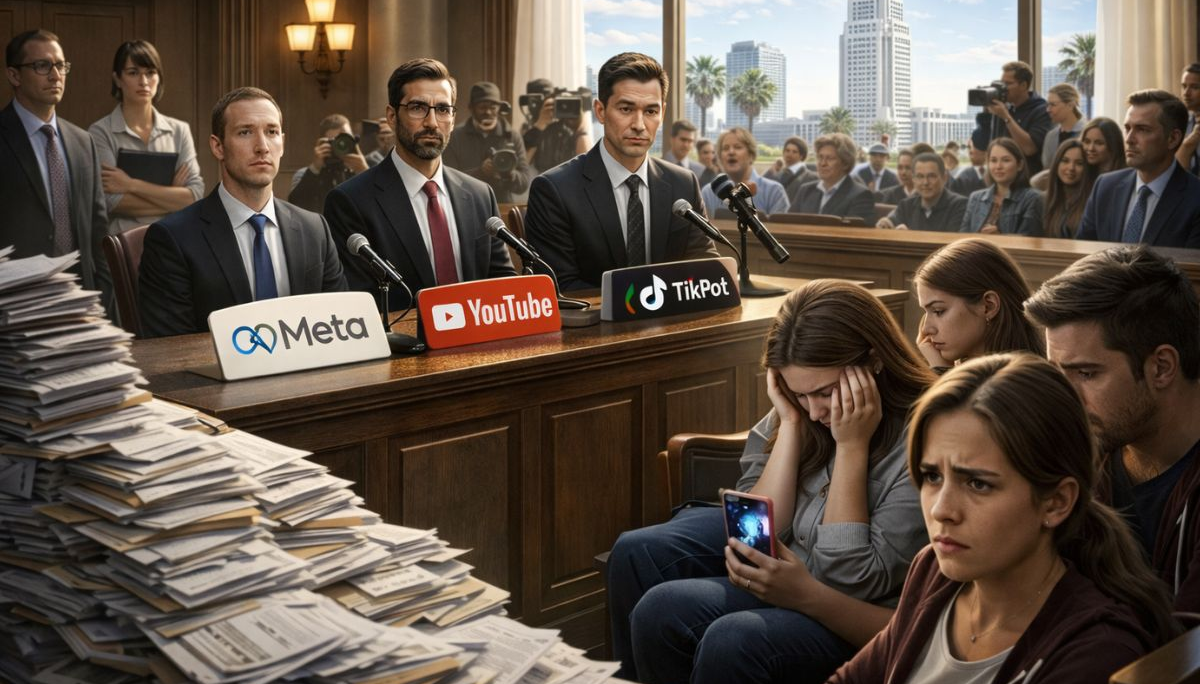
Parents, Teens, and Schools Take Meta, YouTube, and TikTok to Historic Trial in Los Angeles, Accusing Platforms of Addiction; CEOs May Testify and Documents Could Reveal Harm to Youth Mental Health – CPG Click Petróleo e Gás
Related Posts
 jun 13, 2026
 jun 13, 2026
 jun 13, 2026