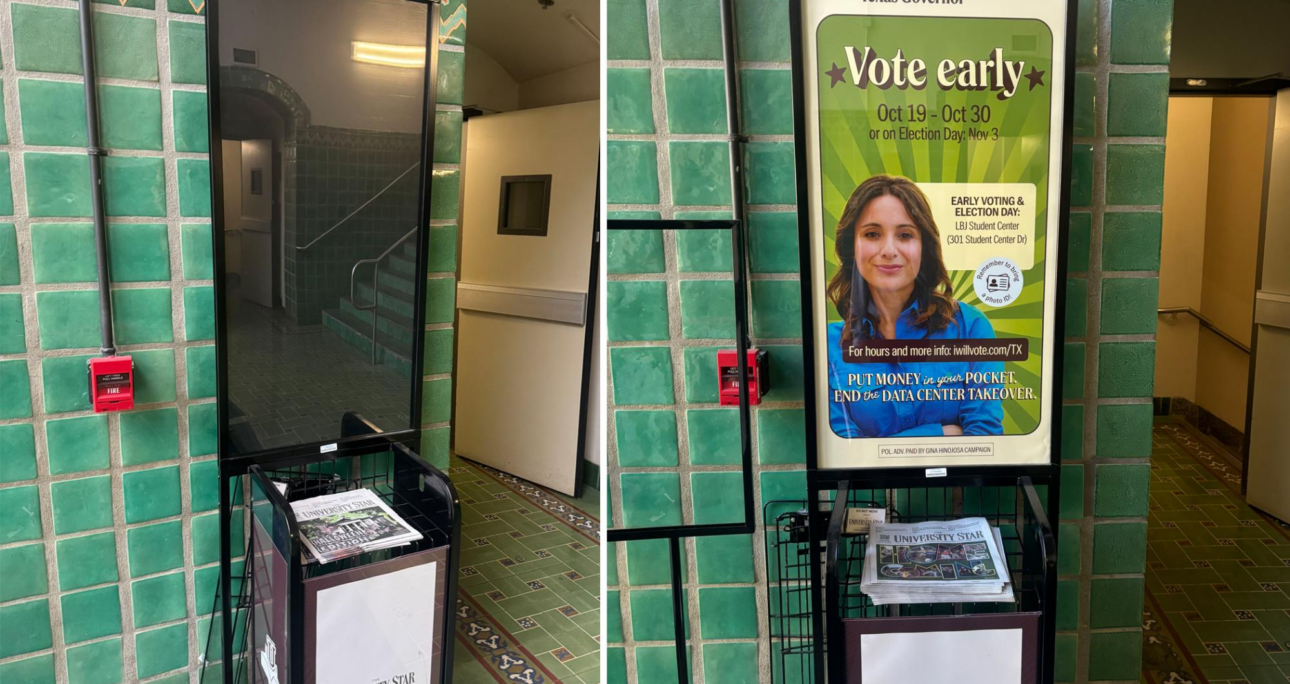
SMPD arrests 4 Texas State students for hazingSan Marcos prepares for severe weather forecastRolled over trailer forces closure of Sessom DriveUniversity Star disputes Texas State’s claims advertisements violate university policyFaculty senate voices parking concernsBobcat football needs to have difficult conversationsJudge rules in former history professor’s favor amidst lawsuitHays County denies Price Center funding requestMissing Texas State student’s remains identified after nearly six years‘Cats go down with the sickness in second half collapse to SDSU in Pac-12 opener If you’re interested in submitting News, click here.If you’re interested in submitting a Letter to the Editor, click here.SubmitThe San Marcos Police Department is maintaining increased patrols on The Square ahead of Halloween, nearly a year after shootings that left one…University administrators removed Gina Hinojosa gubernatorial campaign ads from The University Star’s news racks this week, saying the paid ads violated the university’s policy. Despite university policies that dictate that student staff members decide news advertisements and editorial content, administrators said the advertisements violate a separate policy that keeps candidates from posting signs inside university buildings. The policy does not address student publication advertisements in university buildings. The move drew First Amendment protests from two national organizations, the Student Press Law Center (SPLC) and The Foundation for Individual Rights and Expression (FIRE), after The University Star contacted them for consultation. Both organizations wrote letters of support. “The University Star is not a candidate, and nothing in the policy mentions student publications,” Jonathan Gaston-Falk, a senior staff attorney, wrote in a letter of support from the Student Press Law Center (SPLC), a legal organization that defends and advances the free press rights of student journalists. The university is citing UPPS 06.02.10 Section 07.03(e), which states, “candidates may not …post signs or electioneer inside university buildings.” “That policy provides that ‘Candidates may not’ post signs or electioneer inside university buildings. Section 07.03 frames its guidelines around ‘signs and electioneering near designated polling places during early voting periods and on election day,’” Gaston-Falk wrote. Eric Algoe, Executive Vice President and Chief Operating Officer, told The Star in an email that the university recognizes and supports the editorial independence of student media, but the physical displays on Texas State campus are subject to university policies. “The use of university facilities for certain advertising and solicitation purposes is prohibited. The justification you have offered for using university space does not alter the fact that the proposed use remains inconsistent with university policy governing the use of its facilities. Please be advised that the university’s position regarding use of university buildings and paid advertisements remains unchanged,” Algoe wrote.The ads all clearly state that they are paid for by the Gina Hinojosa campaign. They do not serve as an endorsement by The Star, nor has The Star endorsed any political candidates for the 2026 midterm election. The news racks also have a plaque with the disclaimer that the paid advertising does not reflect the views of the university or the student media. “I am extremely disheartened by the university’s decision to remove advertisements that The Star relies on to operate and produce quality journalism,” Andrew Bencivengo, Editor-in-Chief of The University Star, wrote in a statement. “I have taken repeated steps to resolve this directly with the university, and have received opposing communication as to why this decision was made. This has left me no choice but to assume that this decision was made due to the university trying to exert its power and encroach on our editorial independence.”The Hinojosa campaign purchased similar ads through the same college media buyer at four other public Texas universities: the University of Texas at El Paso, Texas A&M University, University of Houston and the University of Texas at Dallas. Student media staff at those universities informed The Star that their ads were not removed; however, some of them had already ended their contractually agreed-upon time.The dispute began on Oct. 23, when The University Star’s faculty advisor first received a question via phone call from the Chair of the Journalism Department and later a request to take the ads down from Texas State’s Vice President for Marketing and Communications Sandy Pantlik. After the notice, in an attempt to work with the Texas State administration, The Star immediately went and flipped the ads around so they were not showing. However, after consultation with First Amendment lawyers, The Star determined that it was within its rights to post the ads and informed the university of its argument on Oct. 26 and its intentions to flip the ads back over via a letter from the Editor-in-Chief.“In short, the editors of The University Star feel Texas State University is trying to exert its power to control student media by incorrectly demanding these posters come down,” the letter stated. After waiting nearly a full day for a response from the university, the Star staff flipped the ads back over Oct. 27. The Star noticed the advertisement was first missing from the Flowers Hall location on the morning of Oct. 28, then noticed they were all removed from other locations later on the same day. The ads were removed without response from administration until The Star reached out to Pantlik on Oct. 28 at 9:36 a.m. The Star offered to remove the advertisements from the LBJ Student Center, since it was a polling place, in a good-faith attempt to address the university’s concerns about electioneering. The Star received a response from Algoe, who wrote in an email to The Star that the university welcomes the opportunity to meet with The Star to discuss “the possibility of distribution rack options that support the newspaper’s operational needs while adhering to university policies.” “Given your stated intention not to comply with the university’s position on this matter, the university has taken steps to enforce its policies by removing the advertisements from display racks located on the campus,” Algoe wrote in an email to The Star. The Star receives money from Texas State; however, to remain operational, The Star generates additional money through ad revenue. One way The Star books ads is through a service called flytedesk, a non-partisan ad booking service that allows The Star to book national and statewide ads. Through flytedesk, Hinojosa’s campaign booked ads with The Star to display ad panels above newspaper racks. The news racks were acquired by the university for The University Star’s advertising program. The Star ran eight panels for Hinojosa’s campaign from Aug. 23 to Sept. 23. Later, The Star agreed to run five panels from Oct. 19 to Nov. 3. The campaign then booked four additional panels to run for the same time. The Star will be paid by flytedesk after the ads run, and for every day the ads are not posted, The Star can not earn revenue from those ads. “The advertisements can be picked up in the facilities main office during regular business hours,” Algoe wrote in an email to The Star.Algoe wrote that the flytedesk agreement does not create a valid or binding contractual obligation on the university.First Amendment advocates are concerned about the university’s request.“University Star editors will certainly be chilled from accepting and publishing political advertisements on news rack after this incident. In short, TXST cannot hide behind its own policies to commit a violation of The University Star’s First Amendment rights,” Marie McMullan, program manager and counsel for the Student Press Freedom Initiative at FIRE, wrote in a letter of support to The Star. The Star is working to schedule a meeting with Algoe. Editor-in-Chief Andrew Bencivengo, who has been working with the administration in the dispute, was not involved in writing this article, nor was University Star Director and Faculty Advisor Laura Krantz. FIRE letter of support:SPLC letter of support:NewsLife & ArtsSportsOpinionsMultimediaPodcastsStar Merch!ClassifiedsAdvertisingAboutMeet the StaffContactJobsDonate© Copyright 2024 The University Star 601 University Drive, San Marcos, TX | Privacy Policy© Copyright 2024 The University Star 601 University Drive, San Marcos, TX | Privacy Policysource
University Star disputes Texas State’s claims advertisements violate university policy – The University Star
Related Posts
 nov 1, 2026
 nov 1, 2026