
Humans with Agents drive customer success together.
Boost pipeline, win rate, and revenue with Sales Cloud.
Cut service costs with humans & AI agents on one platform.
Evolve how marketers work by harnessing AI to personalize and automate customer communications across every channel, at scale.
Increase revenue and deliver consistent customer experiences across online, in-store, and mobile channels with Commerce Cloud.
Empower every user, in every industry to transform trusted data into actionable insights, wherever they work.
Bring your people, agents data, apps and Salesforce solutions to where work happens in Slack.
Find more customers, win their business, and keep them happy with tools that help you work smarter, not harder.
Bring together, understand, and act on all your data, from any source.
Build and customize your Agentforce and Customer 360 with the Salesforce Platform.
Sustainability, simplified with Agentforce.
Reach your goals with our customer success experts.
Connect with agents, apps, and experts that help you build, launch, and grow your business.
(formerly AppExchange)
Find pricing options for each Salesforce product.
Enter your company’s specific needs and receive custom pricing details.
Flexible ways to buy Salesforce consumption services, from experimentation to transformation.
Drive a lifetime of loyalty.
Deliver the connected future, faster.
Achieve operational excellence.
Deliver profitable growth.
Deliver connected education journeys for life on the #1 AI CRM.
Lead the energy transition.
Empower your customers’ financial success with trusted AI.
Accelerate outcomes with Agentforce 360 for Health.
Improve clinical and commercial outcomes with Agentforce 360 for Life Sciences.
Connect the value chain.
Cultivate loyal audiences faster.
Build relationships that drive change.
Increase client trust.
Modernize government service.
Smarter retail starts with Salesforce.
Drive cost-efficient growth with intelligent automated processes.
Deliver connected experiences.
Explore success stories from customers of all sizes, in every industry.
Explore success stories of how Salesforce uses our own technology to run every part of our business.
Meet the innovators driving business impact and building successful careers with Salesforce.
Catch all the groundbreaking innovations, inspiring keynotes, and unforgettable moments now streaming free on Salesforce+.
Join the list to be among the first to know when registration opens and receive the latest Dreamforce announcements.
Discover what it means to become an Agentic Enterprise, where humans, agents, and platforms together promote customer success.
Explore groundbreaking innovations powered by the #1 AI CRM to drive customer success and transform your enterprise.
Relive the innovation and inspiration of TDX 2026 with on-demand keynotes, sessions, and highlights available anytime on Salesforce+.
Sign up today for an exclusive low price, speaker announcements, and a sneak peek at the deep technical sessions and hands-on workshops.
Discover how to build your Agentic Enterprise with Salesforce and unlock the power of humans and agents driving customer success together.
Explore the biggest announcements, launches, and innovations from TDX 2026.
Relive the marketing event of the year, where bold marketers and breakthrough agents come together to drive big impact.
Sign up now for exclusive savings, speaker announcements, and a sneak peek at the hands-on sessions, AI innovations, and networking experiences.
Learn how companies are navigating AI agents, agentic marketing, and the future of customer experiences.
Join leaders at Salesforce as they tackle the role of the agentic marketer and new innovations for the Agentic Enterprise.
The data and analytics event of the year, where AI, analytics, and trusted data come together to power better decisions.
Sign up now for exclusive savings, speaker announcements, and a sneak peek at the deep technical sessions and hands-on workshops.
Stream Tableau Conference highlights on demand; keynotes, sessions, and more available anytime on Salesforce+.
Watch the Tableau Conference Keynote and go from seeing to doing with agentic analytics.
Ignite your data strategy, unlock AI’s full potential, and lead your organization into the future.
Watch this year’s Informatica World General Sessions on demand, from anywhere.
Catch up on everything you missed and get the insights you need to unlock the full potential of your data.
Join us in cities around the world to experience the latest Salesforce innovations in apps, data, and agents. Connect with leaders and experts from your industry at an AIforce World Tour near you.
Browse current AIforce World Tour events, or sign up today to be the first to know when one is coming to a city near you.
Experience breakthrough innovations from Dreamforce with 160+ expert-led sessions, live demos, and hands-on trainings. Discover what’s possible when AI meets the #1 CRM. All in one day, all for free.
Explore the latest innovations from Dreamforce through expert-led sessions, live demos, and hands-on learning you can put to work right away. All in one afternoon, all for free.
Fuel your professional growth and transform your company with our free live streaming and on-demand events.
Stream the world’s largest, most trusted technology event.
Join us to learn how AI agents are driving customer success.
Explore data and AI demos, trainings, and release announcements.
Save inspiring content to watch later.
Dive into highlights from past events and explore on-demand content for every role and industry.
Join live webinars or listen to on-demand webinars at any time.
Learn from peers, build your Salesforce network, and give back to the community.
Build product knowledge and get implementation and adoption guidance from Salesforce experts.
Learn and get hands-on the with the latest product innovations.
Join groups to meet, collaborate, and learn new skills with Trailblazers.
Skill up for the future from anywhere with Trailhead, our free, online learning platform.
Explore guided learning paths to quickly learn in-demand skills.
Accelerate learning with access to Salesforce experts.
Earn resume-worthy Salesforce credentials.
Find your career in the Salesforce ecosystem.
Discover free curriculum and resources for students and educators.
Explore free trial offers for Salesforce data, analytics, and CRM products — for any size business, in any industry.
The marketing, sales, service, and commerce tools you need to succeed — all in a single CRM suite.
Build enterprise-quality apps fast and get hands-on with Agentforce and Data Cloud.
Salesforce is the #1 AI CRM, with AI agents, data, and CRM apps on a single, unified platform.
Learn all about what CRM is, what it does, and how it can improve customer relationships.
Salesforce’s category-leading apps for sales, service, marketing, commerce, IT, and more.
Learn more about AI agents and how they can help your business.
It’s always-on digital labor augmenting every employee, department, and business process to improve customer experiences.
Discover tips and insights from experts to supercharge your digital journey.
Get the latest on AI, data, digital labor, and more.
Keep up with Salesforce’s AI research team and stay on the cutting edge of technology.
Get the latest tooling innovation news, insights, and inspiration.
Grow your career with the latest in sales content, training, and events — all part of the world’s leading sales community.
Find free articles, guides, best practices, research, and more.
Read the latest studies and reports from the world’s best-known business analysts.
Explore industry-leading Salesforce partner apps and experts.
Get developer guides, tutorials, sample code, and API references.
Sign up to receive the latest Salesforce tips and insights, tailored just for you.
Need help? Ask Agentforce. Find documentation, access learning resources, log cases, and more – all the support you need, wherever you need it.
Find up-to-date information and status about our technology bugs and workarounds.
Find tutorials, sample code, developer guides, and API references.
Explore diagrams, decision guides, and resources to build trusted, easy, and adaptable solutions.
Meet people, learn skills, find apps and experts, and share feedback by joining Salesforce communities.
Connect with peers to learn skills and grow.
Connect with Slack end users, admins, and developers.
Connect with MuleSoft developers, architects and business users.
Connect with Tableau analysts, admins, developers and business users.
Collaborate, learn, and manage your partner business.
Help us build the Salesforce roadmap by sharing your feedback.
Reach your goals with our customer success experts.
Get the right level of support and guidance to grow your business.
Implement, innovate, and transform your enterprise with help from Salesforce experts.
Manage your Salesforce subscriptions and contracts.
Make payments, buy products, and manage renewals (Salesforce login required).
Access invoices and make payments (Trailblazer ID login required).
Track and manage consumption with near-real time usage data.
Learn about our history, products, and values.
We are guided by our values and strive to do well in business while doing good in our communities.
Business is the greatest platform for change. We use the full power of Salesforce to make the world a better place for all of our stakeholders.
Start a new journey with us – a career here at Salesforce.
Stay informed with the latest news and announcements, fresh off the press.
Find answers to your questions about Salesforce agreement terms, policies, intellectual property, corporate governance and compliance for customers, employees, partners and suppliers.
Explore the Salesforce brands delivering success now.
Share the story
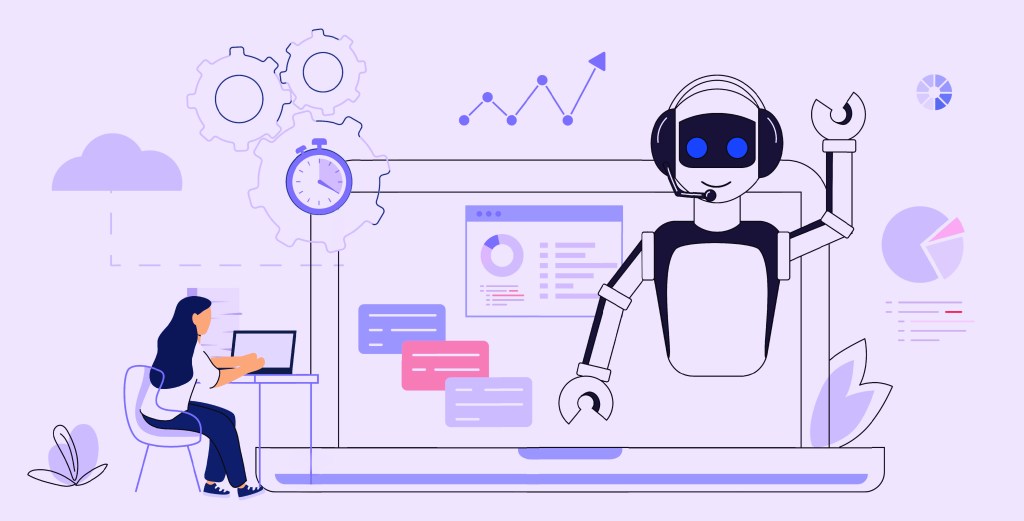
RPA uses software-based virtual bots to automate repetitive or labor-intensive tasks with high accuracy and speed.
By Rei Liao, Product Marketing Manager at MuleSoft
Share the story
Employees spend one-third of their time on routine administrative tasks rather than the skilled work they were hired to do. Not surprisingly, 64% of these workers experience burnout once a month or more. Robotic process automation (RPA) can help address this imbalance.
RPA uses software-based virtual robots to automate labor-intensive tasks. It’s a key part of the growing digital labor market. Digital agents use RPA to gather the data they need for decisions. By combining process automation with agentic AI frameworks, your teams have more time to spend on highly valuable tasks.
RPA uses software-based robots to automate business processes and reduce error risks. But they’re not robots in the physical sense of the word. They’re considered robotic because they can be programmed to take specific actions. Common actions include completing forms, extracting data, and moving files.
Consider a law firm carrying out data discovery for a case. Rather than manually sorting through thousands of documents across hundreds of data sources. Instead, the firm can automate this process, saving both time and money.
Process automation can also improve the performance of digital workers. As a result, RPA is sometimes known as “AI automation” for its role in enabling AI-based processes.
This raises an important question: Is RPA just another form of AI? Not exactly.
Artificial intelligence (AI) refers to technologies like machine learning (ML) that mimic human decision-making. Accurate results from AI, however, require high-quality data. If databases contain duplicate entries or errors, results may be inaccurate.
RPA is rules-based software that automates resource-heavy tasks such as collecting and curating data, which sets up AI tools for success. Together, RPA and AI can automate everything from data collection, evaluation, and entry to decision-making.
Transform the way work gets done across every role, workflow, and industry with autonomous AI agents.
The core of RPA is simple: Software-based robots mimic common human actions such as completing tables, filling out forms, or using applications.
RPA isn’t a monolithic process. Instead, it depends on three components: User interface (UI) interactions, application programming interfaces (APIs), and task scripting.
It’s one thing to discuss the theoretical application of RPA, but what does this look like in practice? Several conditions make business processes a good fit for RPA. First are large data volumes that are regularly updated, such as those in spreadsheets. Next is data stored in multiple locations, such as in the cloud and on local storage servers. Finally, RPA offers a way to bridge the gap between the current generation and legacy IT systems.
Let’s explore three examples in more detail:
RPA reduces the time required to carry out business tasks. But this isn’t the only benefit for your business. In combination with digital agents and human oversight, robotic process automation offers multiple benefits, including:
Reduction in the time and effort required to complete labor-intensive processes means less money spent on these processes. Beyond basic cost savings, companies also see ROI from RPA as staff have more time to drive business value rather than collect data.
RPA solutions don’t deviate from programmed processes. This makes them ideal for tasks that require a combination of repetitive actions and high accuracy. Improved accuracy is also essential for compliance in data handling and security.
Robotic process automation makes it easier for a digital workforce to get the data it needs from legacy CRM solutions and other tools. Consider a customer looking for a tracking update on their package. RPA can direct database tools to find relevant tracking information and relay this data to AI agents, who then inform the customer.
RPA workforce automation tools can help improve the human work experience. Instead of being tasked with data entry, employees can spend their time focused on more strategic and creative work.
It also opens the door for staff reskilling and upskilling. With automated scripts handling manual tasks, businesses can bring employees up to speed with training in responsible AI use or offer more in-depth training in areas such as AI prompt creation. This can lead to internal advancement and promotions, which keeps staff engaged.
The result is threefold: Enhanced productivity, improved morale, and increased opportunities.
RPA can mimic repetitive, predefined human actions while AI can act autonomously to decide the next best action on its own. AI underpins the next generation of digital labor — autonomous agents capable of analyzing data, making decisions, and incorporating generative AI and conversational AI.
RPA supports AI and vice versa. Using RPA, digital workers can automate repetitive tasks like data extraction and web scrapping by having bots mimic user keystrokes and mouse clicks. Using AI, teams can quickly build and deploy RPA bots that tackle labor-intensive tasks.
They can work together in this way because robotic process automation is inherently process-driven. Using predefined workflows, RPA handles repetitive, rules-based tasks, and AI excels at creating these workflows.
Any digital labor platform that uses agentic systems needs access to current databases, legacy apps, and incoming datasets. Here’s what that looks like in practice.
Robotic process automation tools can extract invoice data and input this data into legacy or homegrown invoicing systems.
This underpins a larger quote-to-cash (QTC) sales process that leverages AI agents to create offers, build proposals, manage contracts, and collect payment. While AI handles the heavy lifting, AI for sales isn’t possible without the underlying invoice data collected by RPA.
More data can provide a path for better customer service. Collecting and inputting this data, however, is often time- and resource-intensive. This is because customer data comes in multiple formats — unstructured data — from multiple sources, and is often stored in homegrown databases or spreadsheets. It also helps companies collect and curate this data regardless of origin or location.
Digital labor tools can then leverage this collected data as part of a larger AI for service process that prioritizes personalized interactions and recommendations.
Accurate pricing and product information are required to create effective marketing campaigns. Using RPA, teams can extract pricing data from web pages and store it as a shared resource.
Used as part of a large AI for marketing strategy, this data helps teams build targeted ad campaigns.
Returns remain a cumbersome process for commerce teams. If data isn’t regularly and accurately updated across legacy management and procurement systems, companies may encounter frustrated customers or struggle with inaccurate inventory counts. Using RPA to collect and update order information enables AI for commerce by supplying digital agents with the data they need to process returns.
Salesforce AI delivers trusted, extensible AI grounded in the fabric of our Salesforce Platform. Utilize our AI in your customer data to create customizable, predictive, and generative AI experiences to fit all your business needs safely. Bring conversational AI to any workflow, user, department, and industry with Einstein.
While RPA offers significant advantages for organizations, it also comes with several potential challenges and key considerations. These include identifying processes for workforce automation, managing data quality and integration, navigating ethical governance concerns, and addressing scalability and maintenance needs. Here’s a look at each in more detail.
Not every process is a good fit for automation. Depending on the type of data entered, the application used, and the intended outcome, RPA may not be the best fit. Businesses can identify potential process candidates by creating criteria for selecting suitable processes. Common criteria include:
Once you’ve identified process criteria, you need to find and isolate these processes. Businesses often benefit from using process mapping tools that create visual representations of current workflows and process dependencies. This helps identify where processes exist in your networks, how they’re connected to applications and services, and what data they use.
Effective RPA depends on high-quality data and the ability to integrate this data across legacy systems and modern applications. In practice, this poses challenges including:
Robotic process automation can also introduce concerns around ethical data use. For example, if companies lack visibility into what data is being collected and how it’s being used, the effect could be compliance or legal challenges.
Organizations must navigate concerns such as:
To ensure tools keep pace with growing data volumes and remain reliable, two considerations are critical:
Enterprise AI built directly into your CRM. Maximize productivity across your entire organization by bringing business AI to every app, user, and workflow. Empower users to deliver more impactful customer experiences in sales, service, commerce, and more with personalized AI assistance.
Deployment practices make or break the success of robotic process automation. These best practices can help streamline the process:
Stakeholder engagement is the starting point for any robotic process automation deployment. First, assign ownership of the project to a relevant C-suite member. The buck stops here — all aspects of RPA integration go through this individual. Next, bring in IT teams, front-line users, and any other teams that will interact with RPA, and provide an outline of key objectives. Communicate potential benefits and discuss likely timelines.
Last — and perhaps most importantly — is taking the time to address concerns. Ask teams what they’re worried about, where they see possible roadblocks, and how they believe these problems can be addressed. Skip this step at your peril; failure to engage stakeholders can hamper widespread adoption.
Defined processes and clear policies are critical to ensure the consistent application of RPA. Start by creating a center of excellence (CoE) that defines best practices, identifies possible missteps, and provides actionable advice to address issues.
Next, take the time to develop data governance models and best practices. Governance can be simple — for example, data should always be encrypted and access should be limited — or it may be complex, such as alignment with evolving compliance legislation such as GDPR, CCPA, and guidance from FINRA. Oversight is also critical. While RPA provides the foundation for advanced workforce automation, it’s not self-correcting or self-evaluating. Regular evaluation and testing are critical to ensure accurate output.
Not all vendors are created equal. When selecting a partner, consider:
While it’s tempting to roll out RPA at scale once tools are in hand, it’s better to start with pilot projects. Given the complex nature of IT environments, it’s impossible to know the impact of new tools until they’re deployed. If unexpected errors happen, addressing small issues is easier than handling widespread failures.
Aim to identify the most high-impact, low-risk projects to automate. Subfeatures, such as process mining , can help pinpoint potential process candidates. Once RPA is up and running, measure its impact with metrics — how much time has been saved? Is the data accurate and complete? What feedback do users have about the process?
RPA isn’t a static solution. As data volumes increase and data sources evolve, tools must keep pace. To monitor and optimize performance, start by measuring the efficacy over time. If speed and/or accuracy decline, perform a root-cause analysis to identify the primary problem, rather than treating the symptoms.
Robotic process automation lets your business gather more data, more quickly, and do so from any source. Unlike its AI or cloud-driven counterparts, RPA is rooted in simple scripting, making it ideal for applications that aren’t inherently connected.
Properly applied, it can transform business operations. Connecting with legacy applications means RPA can significantly expand data availability. By sorting through mountains of data, RPA can free up time for staff to take on new projects or develop new initiatives. Plus, by bringing more data to the surface more quickly, RPA sets the stage for improved AI-driven decision-making.
AI solutions such as Agentforce are the brains of digital labor — RPA is the muscle. It does the heavy lifting by collecting and returning data from multiple sources to inform AI actions. Put simply, the better your RPA, the smarter your AI.
Realizing RPA’s potential requires a measured and targeted approach. Businesses are best served by user-friendly, well-supported, and secure solutions — as a result, careful evaluation of available options is critical. Function also outpaces form. While it’s tempting to deploy business-wide, you’re better served by bringing in stakeholders early, addressing potential concerns, and starting with small-scale deployments.
RPA (robotic process automation) uses software-based “robots” to automate business processes. These processes include completing forms, extracting data, and moving files along with other types of repetitive, data-driven tasks.
No. RPA can mimic repetitive, predefined human actions while AI can act autonomously to decide the next best action on its own. RPA supports AI and vice versa. Using RPA, digital workers can automate repetitive tasks like data extraction and web scrapping by having bots mimic user keystrokes and mouse clicks. Using AI, teams can quickly build and deploy RPA bots that tackle labor-intensive tasks.
One simple example of an RPA in practice is syncing data between Salesforce tools and legacy systems that don’t support APIs. Relevant data can be collected from legacy tools and recorded in Salesforce, while key Salesforce data can be integrated with older solutions to ensure operational consistency.
What Is RPA (Robotic Process Automation)? – Salesforce
Related Posts
 out 21, 2026
 out 21, 2026
 out 21, 2026